Research Article
Open Access

Theoretical and Natural ScienceOpen access


Articles in this Volume
Research Article
Open Access
The rapid development and expansion of High-Performance Computing (HPC) systems present signif- icant environmental challenges, primarily due to substantial energy consumption and associated carbon emissions, often from non-renewable sources. This paper provides a comprehensive analysis of the en- vironmental footprint of HPC. It models global energy consumption, considering both full capacity and average utilization rates (estimated at 12-18%). A model is developed to quantify total carbon emis- sions, accounting for diverse energy sources, regional energy mixes, and conversion efficiencies. The analysis explores future trends by considering projected HPC growth, increasing energy demand from other sectors, and potential shifts in energy sources, forecasting impacts up to 2030 using time series analysis. The study further investigates the potential for mitigation by modeling the relationship be- tween increased renewable energy adoption and carbon emission reductions, including a scenario for 100% renewables. Additionally, the model is expanded to include water usage, another critical environmental factor, analyzing its relationship with energy consumption. Based on these models, actionable technical and policy recommendations are proposed to enhance energy efficiency and promote sustainability in the HPC sector, emphasizing the need to integrate these concerns into future development and climate change mitigation strategies.
Research Article
Open Access
Matrix computation is the basic equipment of modern scientific computation. It provides a necessary tool for solving linear systems and revising models, and analyzing large datasets. In this work, we do a study about the matrix computation, properties, and decomposition techniques. And we emphasize their academic support and practical meanings. Before introducing the methods of the Gram-Schmidt process and QR decomposition, we begin with the basic matrix operations and features. Based on these principles, we explore two main applications: Ordinary Least Squares (OLS) regression for statistical modelling and Principal Component Analysis (PCA) for dimensionality reduction. Moreover, we also discuss the real-world applications in different fields. This work aims to connect the theories of matrix operations with real applications, and it provides a structured perspective for modern data analysis and experimental operations.
Research Article
Open Access
Under the impetus of the "double - carbon" goal, wind power, as one of the main forms of new - energy power generation, has been growing in significance. However, the unpredictability of wind power output has presented difficulties for the secure and stable operation of the power system as well as real - time scheduling plans. Regarding the issues that the prediction of wind power output based on the traditional BP neural network has a slow convergence rate and is prone to getting trapped in local optima, this paper puts forward a hybrid wind - power prediction model (PSO - BP), where the BP neural network is enhanced by the particle - swarm optimization (PSO) algorithm. This approach optimizes the initial weights and thresholds of the BP neural network via the global search of the PSO algorithm. As a result, it enhances the model's convergence capacity and, to some degree, circumvents the problem of local optimality.Public wind - power datasets are utilized in the experiments. The PSO - BP and traditional BP models are trained and tested multiple times under the same circumstances. The outcomes indicate that, in comparison with the traditional BP model, the PSO - BP model, while ensuring the convergence speed, mitigates the local optimization issue of the neural network. It significantly improves the reliability and precision of the model's prediction results. Moreover, it offers robust technical backing for the short - term prediction of wind power, which is conducive to improving the power - system consumption plan and ensuring its safe operation.
Research Article
Open Access

Traditional soft robotic manipulators with circular cross-sections face inherent challenges in balancing flexibility and stiffness, particularly in precision-demanding applications such as medical and agricultural tasks. Inspired by the biomechanical superiority of the seahorse tail—characterized by its square-prismatic vertebral architecture and modular segmentation—this study proposes a novel variable-stiffness manipulator. The design integrates 3D-printed rigid skeletons (mimicking seahorse osteoderms) and silicone-based joints with embedded pneumatic airbags, enabling anisotropic stiffness modulation. Through finite element analysis (FEA) and multi-body dynamics simulations, the mechanical behavior was optimized, followed by experimental validation. Results demonstrated that increasing airbag pressure from 100 kPa to 200 kPa enhanced stiffness by 368% (from 4.92 N/mm to 23.04 N/mm), aligning with the hypothesized nonlinear pressure-stiffness relationship derived from hyperelastic silicone behavior. Static bending tests confirmed linear stress-displacement correlations (R²=0.987), validating the effectiveness of modular joints in dispersing stress concentrations while maintaining global stability. These outcomes directly address the initial hypothesis that square-prismatic geometry and pneumatic actuation can reconcile compliance and load-bearing capacity.
Research Article
Open Access
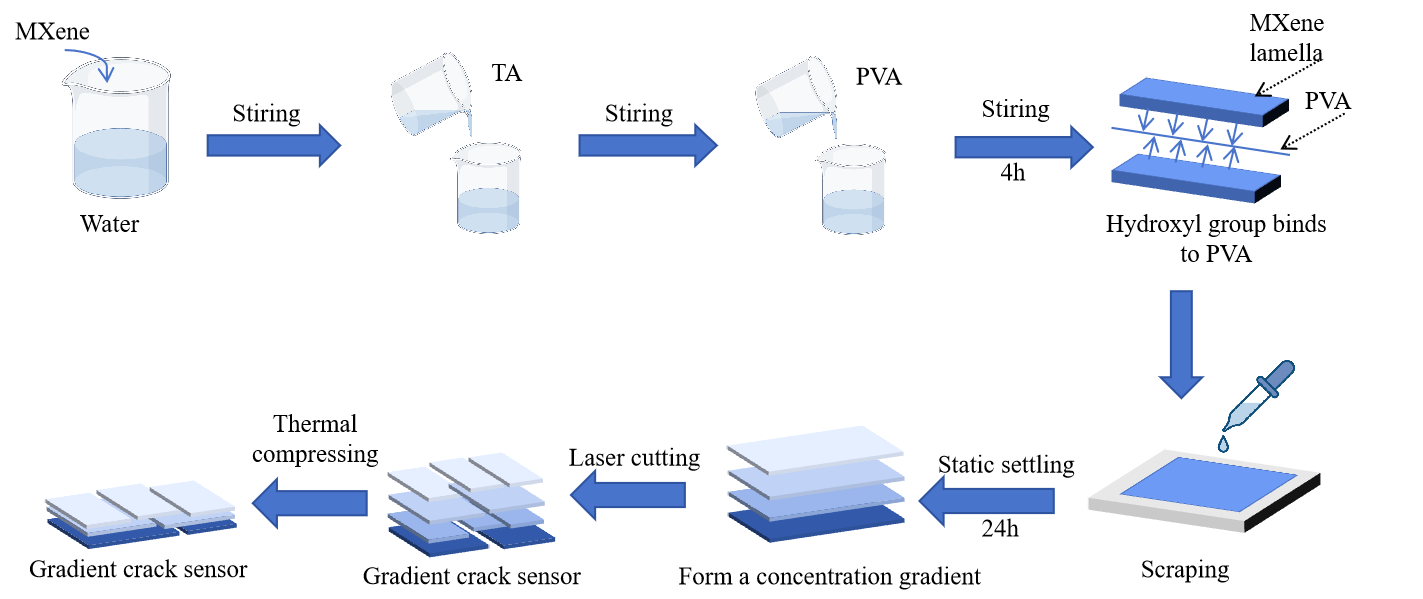
This study presents an innovative flexible strain sensor with high sensitivity, robust mechanical properties and rapid response through the novel design of a Janus gradient concentration structure combined with laser-thermocompression synergistic processing. The sensor employs MXene as the conductive unit, with polyvinyl alcohol (PVA) and tannic acid (TA) serving as the flexible substrate and interfacial reinforcement agent, respectively, achieving high sensitivity through gradient concentration distribution. Laser etching pre-engineered periodic primary cracks in the high-concentration MXene layer, while thermocompression induced the formation of a multi-level secondary crack network within the gradient layers, establishing strain-sensitive quantum tunneling conduction pathways. Experimental results demonstrated that the sensor exhibits an exceptionally high gauge factor (GF) along with ultra-fast response time. Mechanistic analysis revealed that the gradient structure synergistically enhances sensitivity through strain amplification effects and hierarchical crack propagation mechanisms. Simultaneously, the TA-mediated interfacial hydrogen-bond network coupled with the elastic recovery characteristics of PVA collectively ensures mechanical durability. This sensor demonstrates precise monitoring capabilities for human joint movements and pulse waveforms, providing a high-performance sensing solution for wearable electronics and soft robotics.
Research Article
Open Access
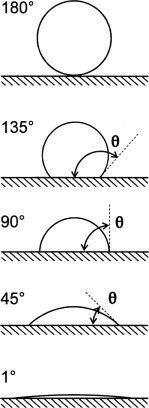
Fluorinated compounds are commonly used to produce durable water repellent (DWR) coatings, but they also have adverse environmental impacts, which has led to the exploration of alternative environmentally friendly products. This study illustrates that biomimetic hydrophobic coatings provide new ideas for solutions by describing some natural materials, such as lotus leaves and cactus thorns. However, scalability challenges and poor durability also limit their application. Although etching and photolithography can replicate natural structures, they are costly and require high industrial scale. Therefore, this study illustrates the shortcomings of these current technologies and future research directions. Innovative materials need to have similar functions as fluorinated coatings, but without the adverse impact on the environment. This study also emphasizes that future coatings need to perform well in multiple aspects such as waterproofing, self-healing, antibacterial, and UV resistance to meet the needs of more industries.
Research Article
Open Access
This essay explores the interrelationship between Ramanujan summation, the Riemann zeta function, and divergent series. the connection between Ramanujan summation, the Riemann zeta function, and divergent series will be explored. My objective is to illustrate how Ramanujan summation can be interpreted in a way to assign values to divergent series, thus extending classical convergence and gaining better understanding of infinite sums. Originally going back to the development of convergent series the Riemann zeta function is a fundamental element in analytic number theory and produces an architecture for understanding how prime numbers are distributed. Finally, I test the accuracy of the Ramanujan series and the analytical equation by presenting the special divergent series from the sum of all natural numbers. It may not be an intuitive outcome from a more elementary viewpoint, but it has been obtained in the overseas of some complicated mathematics and appears in the application of theory physics, for example; cable theory and Casimir effect computations involving infinite series sums that naturally emerge in quantum field theory.
Research Article
Open Access
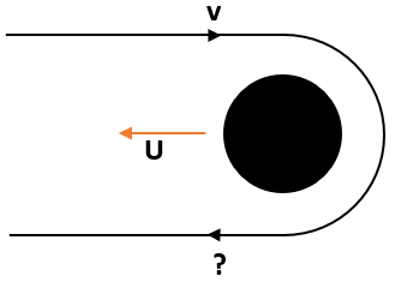
The gravitational slingshot effect, also known as gravity assist or gravity assist. As we know, it is a technique that uses the gravitational field of a celestial body to increase the speed and trajectory of a spacecraft in outer space. In this paper, the basic rules of how gravitational slingshot works are discussed, and the calculation formula of slingshot velocity is according to the conservation of momentum and energy. We also look at a realistic situation. When there is an angle, and came up with a second formula for speed. We used Python programming to simulate trajectories of different qualities and speeds and made a table to compare the differences in different situations. Gravity slingshot focuses on making the orbits of missions. The article also looks at successful cases that have used the technology, such as Voyager and spacecraft, to illustrate its practical applications and benefits. The goal is to enhance the understanding of how gravity slingshots can be used to achieve efficient and cost-effective space travel.
Research Article
Open Access
This study explores the relationship between stock prices and a company’s intrinsic value by applying a comprehensive mathematical and empirical framework. Key financial models-including the Discounted Cash Flow (DCF) model, the Capital Asset Pricing Model (CAPM), and the Fama-French Three- and Five-Factor Models-are utilized to estimate intrinsic value and examine deviations in market pricing. While the Efficient Market Hypothesis (EMH) suggests that stock prices fully reflect all available information, real-world data often reveal consistent mispricing driven by behavioral biases, investor sentiment, and practical constraints on arbitrage. Using Apple (AAPL) as case studies, the paper estimates intrinsic values via DCF and analyzes price deviations using time-series econometric techniques and regression diagnostics. Findings show that mispricing can persist over time, and prices tend to correct gradually rather than instantly, implying semi-strong market efficiency. The study offers valuable insights into the limits of rational arbitrage, the dynamic nature of market corrections, and the influence of noise traders in modern financial markets.
Cookies are used by this site.
Copyright © 2026 EWA Publishing, its licensors, and contributors.