

About TNSThe proceedings series Theoretical and Natural Science (TNS) is an international peer-reviewed open access series which publishes conference proceedings from a wide variety of disciplinary perspectives concerning theoretical studies and natural science issues. TNS is published irregularly. The series publishes articles that are research-oriented and welcomes theoretical articles concerning micro and macro-scale phenomena. Proceedings that are suitable for publication in the TNS cover domains on various perspectives of mathematics, physics, chemistry, biology, agricultural science, and medical science. The series aims to provide a high-level platform where academic achievements of great importance can be disseminated and shared. |
| Aims & scope of TNS are: ·Mathematics and Applied Mathematics ·Theoretical Physics ·Chemical Science ·Biological Sciences ·Agricultural Science & Technology ·Basic Science of Medicine ·Clinical and Public Health |
Article processing charge
A one-time Article Processing Charge (APC) of 450 USD (US Dollars) applies to papers accepted after peer review. excluding taxes.
Open access policy
This is an open access journal which means that all content is freely available without charge to the user or his/her institution. (CC BY 4.0 license).
Your rights
These licenses afford authors copyright while enabling the public to reuse and adapt the content.
Peer-review process
Our blind and multi-reviewer process ensures that all articles are rigorously evaluated based on their intellectual merit and contribution to the field.
Editors View full editorial board

Galaţi, Romania
floriann@univ-danubius.ro

Chicago, US
drmarwan.omar@gmail.com

Sydney, Australia
s.seifimofarah@unsw.edu.au

Birmingham, UK
mnawaf@captechu.edu
Latest articles View all articles
Ground effect aerodynamics plays a crucial role in the performance of modern racing cars, particularly in the interaction between the underbody geometry and the ground. This article reviews several key parameters related to the underbody and key working clearance that affect the ground effect flow field and aerodynamic efficiency, including ride height, the geometry of the underfloor inlet and Venturi channels, the geometry of the diffuser, and the sealing structures at the floor edges or sides. Special attention is paid to how these parameters affect the mass flow rate, pressure distribution, boundary layer development, flow separation, and the formation mechanism of vortex structures. Existing literature indicates that the most powerful and consistent evidence currently focuses on the coupling effect between ride height and the geometry of the diffuser. Changes in these parameters can trigger different force field patterns, separation states, vortex disintegration, and even lag phenomena in certain configurations. However, results from simplified bluff-body and diffuser models should primarily be interpreted as evidence for ground-effect mechanisms rather than as direct design rules for complete modern racing cars. Cross-research comparisons are also limited by differences in model configuration, Reynolds number, moving ground conditions, force definitions, and reference areas. Therefore, future research should focus more on multi-parameter coupling, consistent dimensionless comparisons, and aerodynamic robustness under dynamic riding heights, wheel wake, yaw, non-uniform intake conditions and other real operating disturbances.

 View pdf


The Frobenius Coin Problem is a classic mathematical puzzle that asks for the largest unrepresentable integer using a given set of relatively prime coin values. Beyond finding this maximum number, exploring how the number of combination solutions grows is equally important. This paper focuses on calculating the asymptotic growth rate of these combinations, moving from the basic two-coin case to a general k-coin scenario. Instead of relying on pure algebraic estimations, which easily fail for three or more coins, this study uses a continuous complex analysis framework. The discrete counting problem is converted into generating functions, and Cauchy's Residue Theorem is applied. By analyzing the dominant highest-order pole at z=1 and using the Leibniz rule, the asymptotic growth rate for k coins is strictly determined as n k-1 /(k-1)!a 1 …a k . This analytical approach successfully overcomes the dimensional limitations of traditional algebra. Ultimately, it provides a systematic blueprint for understanding combination behaviors in broader linear Diophantine equations.
View pdf
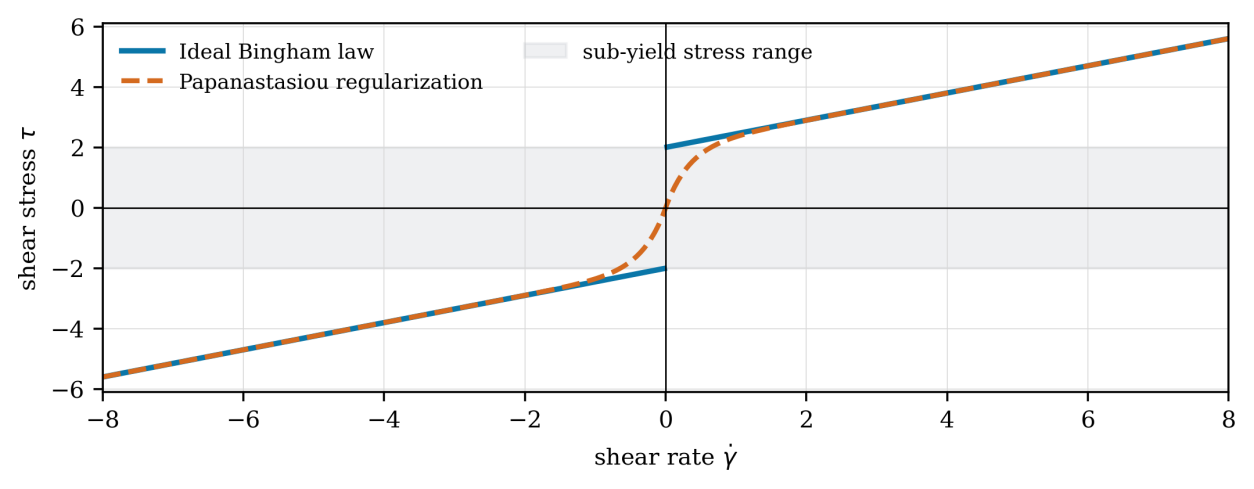
Bingham fluids combine a finite yield stress with an approximately linear post-yield relation between shear stress and shear rate. This compact model is widely used for pastes, slurries, drilling muds, cementitious materials and other viscoplastic media, yet its apparent simplicity conceals the free-boundary problem created by yielded and unyielded regions. This article reviews the constitutive basis of the Bingham model, analytical results for simple flows, and numerical strategies based on regularization, finite elements and the lattice Boltzmann method. The review emphasizes that yield surfaces are stress-defined rather than material interfaces and that regularization parameters must be checked against mesh and time-step sensitivity. A feasible research object is then developed: transverse wire cutting of a freshly extruded cementitious filament. The wire is treated as a translating cylinder in a low-Reynolds-number yield-stress medium. A dimensionless analysis based on the Bingham number separates viscous-dominated, mixed and yield-dominated cutting regimes, while a transparent resistance scale links yield stress, plastic viscosity, wire diameter and cutting speed. The analysis shows why slower cutting does not necessarily minimize resistance when structural rebuilding raises the yield stress. A combined rheometry, force-measurement and regularized-flow simulation protocol is proposed. The Bingham model is suitable as a baseline for process design, but thixotropy, elasticity, wall slip, particle size and fracture must be added when they control the observed cutting response.
View pdf
Earthquakes are among the most destructive natural events, yet their immediate cause is mechanical: processes at work within the Earth's crust. This paper approaches earthquakes from a physical standpoint, following three closely related processes—fault activity, stress accumulation, and energy release—and draws on the literature together with a case study of the 2008 Wenchuan earthquake to trace how the three interact. Tectonic motion keeps loading faults, but friction can hold that motion in check, so stress and elastic strain energy build up slowly in the surrounding rocks. Once the accumulated stress grows large enough to overcome the resistance on a fault, rapid slip and rupture may follow, and the stored energy is released in several forms, including seismic waves, fracture energy, frictional heat, and permanent deformation. The Wenchuan case is instructive: crustal deformation in the region had been comparatively slow, yet a great earthquake still occurred once enough stress had gathered and rupture spread through a complex fault system. Clarifying how fault motion, stress buildup, and energy release fit together therefore helps explain earthquake mechanisms and gives seismic-hazard assessment and disaster-risk reduction a firmer scientific basis.
View pdf
Volumes View all volumes
Volume 199October 2026
Find articlesProceedings of the 4th International Conference on Applied Physics and Mathematical Modeling
Conference website: https://2026.confapmm.org/
Conference date: 23 October 2026
ISBN: 978-1-80915-052-3(Print)/978-1-80915-053-0(Online)
Editor: Anil Fernando
Volume 198October 2026
Find articlesProceedings of ICBioMed 2026 Symposium: Biomedical Engineering and Smart Medicine
Conference website: https://2026.icbiomed.org/
Conference date: 2 October 2026
ISBN: 978-1-80915-040-0(Print)/978-1-80915-041-7(Online)
Editor: Li Zhang , Alan Wang
Volume 197October 2026
Find articlesProceedings of the 6th International Conference on Biological Engineering and Medical Science
Conference website: https://2026.icbiomed.org/
Conference date: 16 October 2026
ISBN: 978-1-80915-038-7(Print)/978-1-80915-039-4(Online)
Editor: Alan Wang
Volume 196October 2026
Find articlesProceedings of CONF-APMM 2026 Symposium: Applied Mathematics and Quantitative Modeling
Conference website: https://2026.confapmm.org/
Conference date: 23 October 2026
ISBN: 978-1-80915-036-3(Print)/978-1-80915-037-0(Online)
Editor: Maira Khalid , Anil Fernando
Announcements View all announcements
Theoretical and Natural Science
We pledge to our journal community:
We're committed: we put diversity and inclusion at the heart of our activities...
Theoretical and Natural Science
The statements, opinions and data contained in the journal Theoretical and Natural Science (TNS) are solely those of the individual authors and contributors...
Indexing
The published articles will be submitted to following databases below: