Articles in this Volume

Research Article Open Access
Advances in the Application of Small‑Molecule Probes in the Study of Cellular Signaling Pathways
Article thumbnail
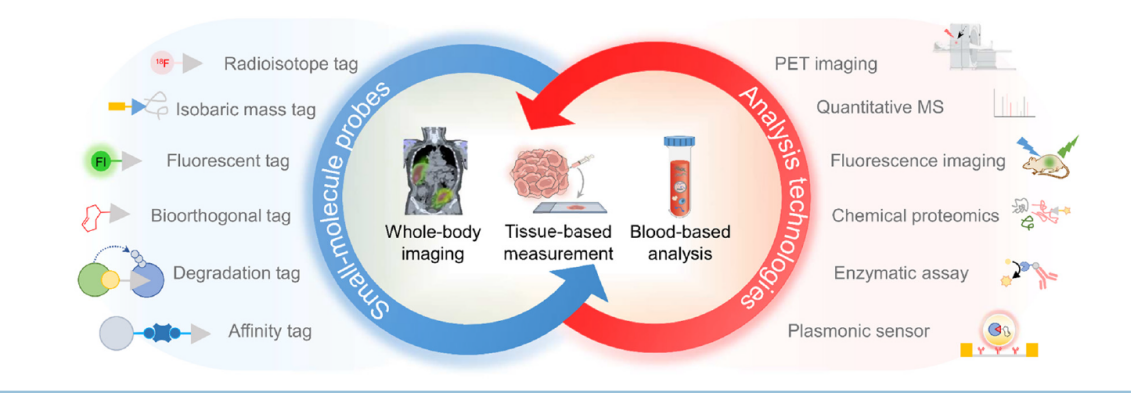
Small-molecule probes are functional organic compounds of simple structure that can selectively recognize and report changes in specific biochemical molecules within the intracellular space. In recent years, with the rapid evolution of chemical biology, rationally designed small - molecule probes have become important tools for dissecting complex cellular signaling networks. For example, when it was the 1980s, Roger Y's laboratory. Tsiendeveloped calcium ion (Ca2+) indicators such as BAPTA and Fura‑2, which pioneered Ca2+imaging technologies; Pan and colleagues emphasized in a recent review that progress over the past decade has been remarkable and that probes have been widely applied to the study of proteins, signaling pathways, and drug–target interactions.The present review comprehensively summarizes the definition and design fundamentals of small-molecule probes, paying attention to the structural design of the recognition moiety, reporter element, and linker area. It then studies major probe kinds, such as imaging probes, activity - based (active - site) probes, and bioorthogonal probes, together with representative cases. At last, it looks into the progress made in using small - molecule probes in kinase - related, Ca2+and redox signaling pathways. By arranging representative studies and commenting on them, this review points up the value of small‑molecule probes in bioimaging, proteomics, and biomarker discovery, and gives an outlook on emerging trends and challenges in probe technology.
Show more
Read Article PDF
Cite
Research Article Open Access
Research Progress of Functionalized DNA Hydrogels in Biosensing
Article thumbnail
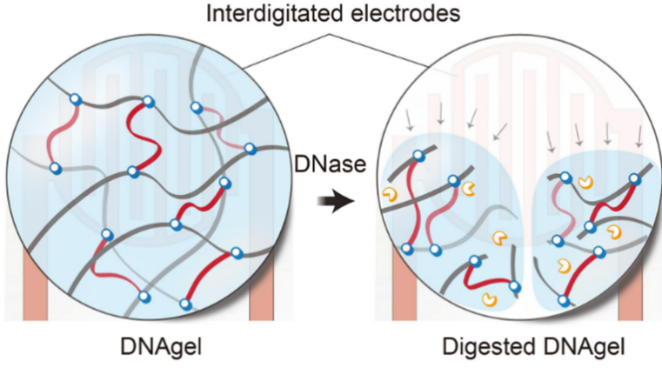
DNA hydrogels are programmable 3D networks that integrate molecular recognition modules (aptamers, DNAzymes, CRISPR) to translate binding events into macroscopic material responses. The central challenge is reliably amplifying these events into quantifiable changes within complex biological matrices. Sensor behavior is governed by coupled factors: material thresholding (gel–sol transition boundaries), pore architecture and mass transport, matrix interference (nucleases, proteins, ionic strength), and readout modality constraints. This review analyzes key scientific questions connecting molecular recognition to signal transduction. We summarize progress in construction routes, functionalization strategies, biosensing applications, and principal bottlenecks in complex samples. Priority directions for clinical translation include thin-film CRISPR geometries with distance readout, wireless integration for longitudinal monitoring, and standardized matrix validation frameworks. Ultimately, translation requires not only low detection limits but also reproducible manufacturing, robust real-matrix operation, and explicit mapping between hydrogel responses and clinically relevant biomarker ranges.
Show more
Read Article PDF
Cite