Articles in this Volume

Research Article Open Access
Flow Separation Control and Aerodynamic Enhancement Mechanism of Bionic Micro-structured Airfoil at Low Reynolds Numbers
The airfoil is prone to flow separation under low Reynolds number flow conditions, which leads to a sharp deterioration of aerodynamic performance of micro aircraft. This paper proposes a bionic separation flow airfoil design concept, which turns to fix the separation point through the leading edge sharpening structure and induce stable vortices, combined with the rear edge arc airfoil surface to promote flow reattachment and vortex stability. Numerical simulation results show that This bionic airfoil can effectively suppress flow separation over a wide Angle of attack (8°-16°), significantly increase lift coefficient, significantly improve stall characteristics, and extend the efficient operating range by about twice compared to traditional airfoils. Parameter analysis reveals the influence of key geometric parameters such as the leading edge tip Angle and the installation position of the arc wing on aerodynamic performance.
Show more
Read Article PDF
Cite
Research Article Open Access
Markov Chain Models in Clinical Performance and Decision Making
Article thumbnail
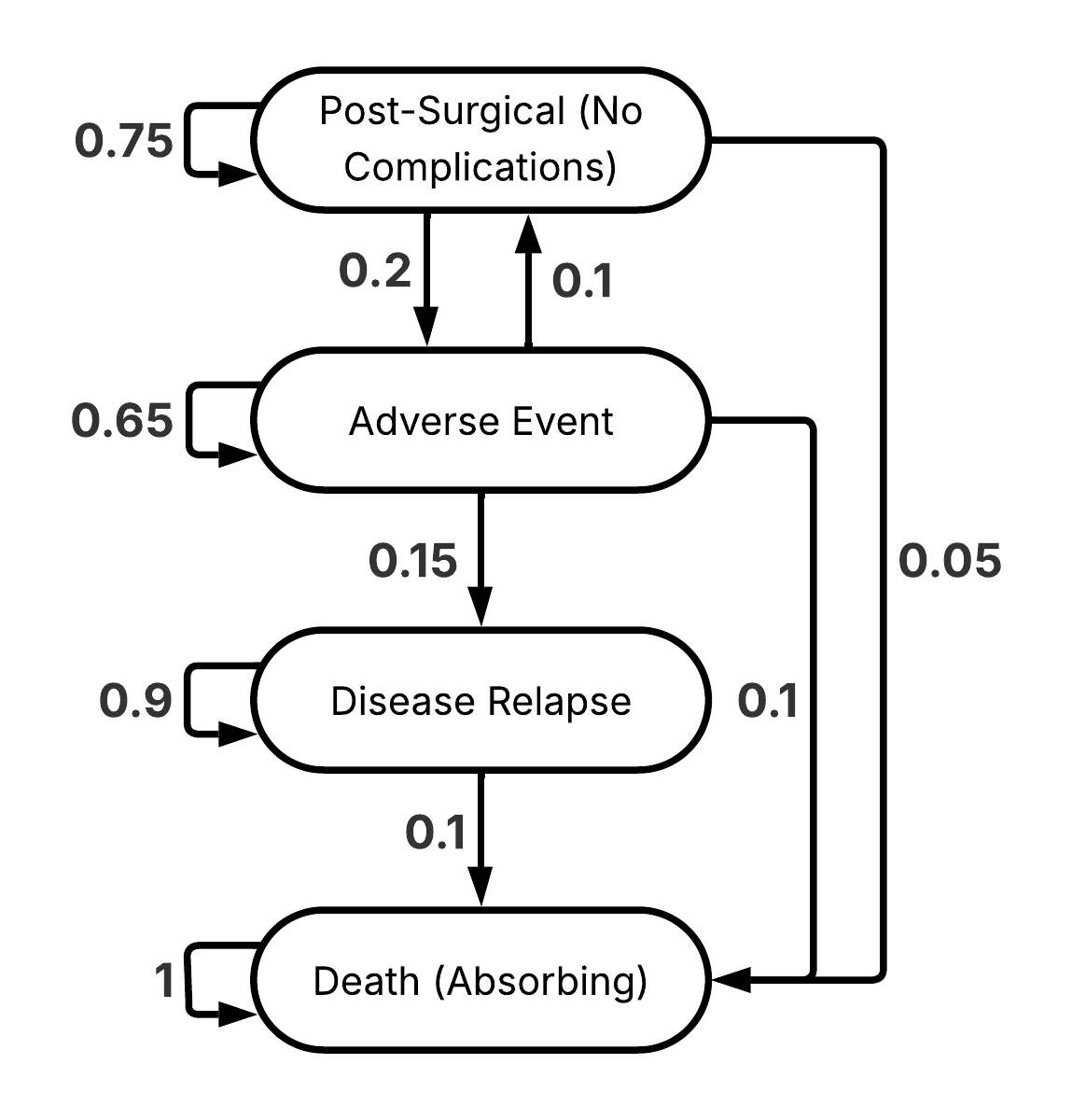
Within clinical research and healthcare decision-making, stochastic modeling methods are becoming increasingly more necessary due to the complexity of predicting the results of clinical processes, disease progression, and analyzing the effectiveness of various treatments. Markov chain models in particular present a good mix of accuracy and simplicity for modeling healthcare outcomes. This study presents a detailed overview of the theoretical foundations of Markov chain models while also discussing their application in patient risk stratification, clinical decision-making, and cost-effectiveness analysis of treatments. Both the advantages and disadvantages of Markov chain models like the memoryless assumption, data requirements needed, and state complexity particularly in healthcare contexts, are examined. Possible future directions for Markov chain modeling, namely hybrid modeling approaches and Markov decision processes (MDPs), are assessed to compare their ability to improve predictive accuracy and influence healthcare policies with regular Markov chain models. Combined all the elements, this study offers clinical researchers and policymakers a comprehensive reference on the strengths and weaknesses of Markov chain modeling specifically in healthcare applications.
Show more
Read Article PDF
Cite
Research Article Open Access
The Existence of Classical Solutions to Fractional Mean Field Games
Article thumbnail
This paper investigates the existence and properties of solutions to a class of stationary fractional mean-field games. The system is coupled with a Hamilton Jacobi Bellman equation with a fractional Laplace operator and a steady fractional Fokker Planck equation describing the agent distribution. Compared to traditional second order diffusion models, the fractional dynamics considered in this paper better characterize stochastic processes with anomalous diffusion properties. The authors explore the normality, uniqueness, and asymptotic behavior of the agent distribution density of the system solutions under different nonlocal diffusion orderss∈(1/2,1). Using the variational method or fixed-point theory, it is proven that the stationary system possesses classical or weak solutions under specific monotonicity or growth conditions of the coupled terms. Furthermore, the paper analyzes the impact of the nonlocality of the fractional operator on the game equilibrium state. The results not only generalize classical mean-field game theory but also provide theoretical support for the application of nonlocal diffusion models in economics and social sciences.
Show more
Read Article PDF
Cite
Research Article Open Access
The Existence of Solution to Fractional Fokker-Planck Equations in the Whole Space
Article thumbnail
This paper investigates the existence and regularity theory of steady fractional diffusion equations with first-order convection terms in the whole spaceRn. Specifically, within the framework of the Bessel potential spaceLαp(Rn), we analyze the interaction between the nonlocal operator(-Δ)sand the divergence-type drift termdiv(b(x)m). The main challenges of this study lie in the regularity competition between the fractional diffusion operator and the first-order derivative drift term, and the analytical challenges arising from the lack of compact embedding properties in unbounded regions. The fractional Fokker-Planck equation is an important generalization of the classical Fokker-Planck equation combined with fractional calculus and is a core mathematical model for describing anomalous diffusion and non-Markovian stochastic processes. The classical Fokker-Planck equation mainly characterizes normal diffusion behaviors such as Brownian motion and is suitable for transport processes that are local, memoryless, and obey Gaussian distributions. However, a large number of practical systems (such as diffusion in complex media, movement of biological cells, financial price fluctuations, relaxation in amorphous materials, etc.) exhibit long-range memory, non-local interactions, heavy-tailed distributions, and anomalous diffusion characteristics that deviate from Fick's law, which are difficult to accurately describe using integer-order differential models.
Show more
Read Article PDF
Cite
Research Article Open Access
Joint Multimodal Data Desensitization Mechanism Based on Face-Swapping and Cross-Modal Semantic Alignment
Article thumbnail
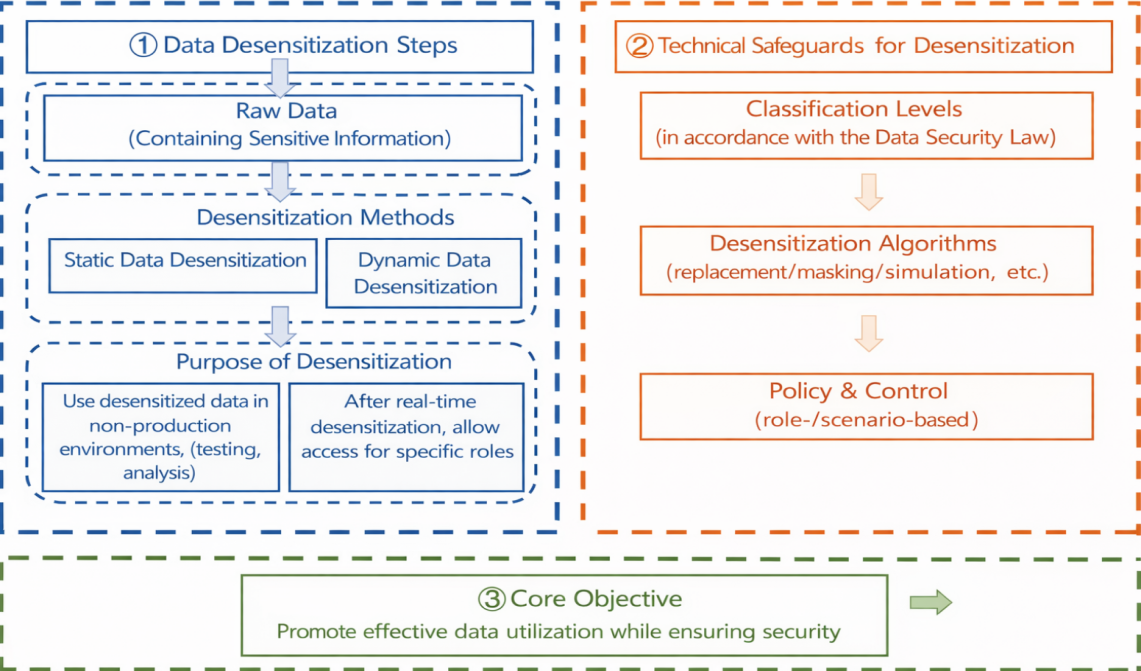
With the explosive growth of multimedia data, the preservation of privacy in multimodal data has become a key research challenge. The traditional desensitization approach for a single data modality often fails to consider hidden privacy correlations between multiple data modalities, resulting in either information leakage or serious data utility loss. In this paper, we propose a joint multimodal desensitization framework to deal with face-related sensitive information in multimodal data. By utilizing Large Language Models (LLM) and YOLO World, we can accurately identify sensitive facial regions in multimodal data. We propose a customized face-swapping approach based on Stable Diffusion and IP Adapter to achieve visual anonymity, coupled with a Variational Autoencoder (VAE) to process text reconstruction. In addition, CLIP-based constraints are used to ensure the semantic consistency of multimodal data. The experimental results show that the proposed approach can reduce the Re-ID rate to 2.1% with high data utility.
Show more
Read Article PDF
Cite
Research Article Open Access
MPM Mathematical Modeling and Numerical Simulation for the Restart Mechanism of Retrogressive Loess Landslides
Article thumbnail
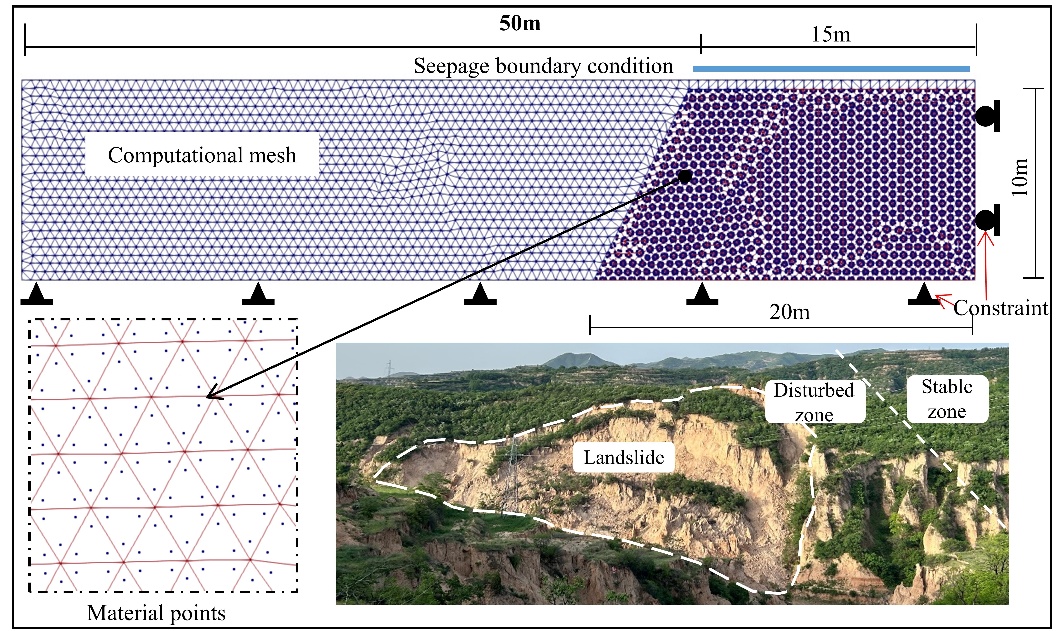
A two-dimensional MPM model of unsaturated two-phase hydro-mechanical coupling was established to address the restart problem of retrogressive loess landslides under irrigation infiltration conditions, with zoning parameters for the disturbed zone and stable zone as well as periodic irrigation conditions set. The results show that the pore pressure in the disturbed zone responds more rapidly, forming a continuous high pore pressure zone from 0.5 s to 25 s, with the first displacement penetration and shear localization occurring at 155 s and 162 s respectively; concentrated deformation reoccurs at the new rear edge and the landslide restarts at 625 s, 700 s and 900 s. The model well reveals the chain mechanism of "sliding-disturbance-seepage-resliding".
Show more
Read Article PDF
Cite
Research Article Open Access
Belief Propagation Algorithm Based on Perturbed Message Passing for Solving Constraint Satisfaction Problems
Article thumbnail
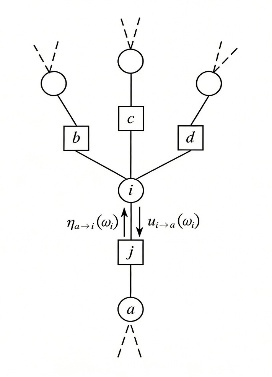
Constraint satisfaction problems usually exhibit a distinct satisfiability transition phenomenon under stochastic models, and an exact phase transition threshold has been strictly proven to exist especially in the RB model. Aiming at the difficulty in solving hard instances of the random binary model with growing domains (RB) near the phase transition region, this paper proposes a guided decimation algorithm based on asynchronous belief propagation with gradual perturbation (P-BP). On the basis of the asynchronous BP-guided decimation framework, the algorithm introduces a linear annealing perturbation mechanism, which enables the variable-to-constraint messages to transit smoothly from deterministic update to the style of Gibbs sampling. Meanwhile, in the late stage of decimation, the variable fixing strategy is changed from greedy selection to direct sampling from the marginal distribution, supplemented by an automatic restart strategy with a maximum of 3 restarts. These improvements retain the asynchronous update, damping factor and A/B/C edge processing rules of the original algorithm, while significantly enhancing the stochastic exploration capability and effectively alleviating the problems of message oscillation, local convergence and error propagation of fixed variables in the phase transition region. Research shows that the combination of gradual perturbation with late-stage probabilistic sampling and a restart mechanism provides an effective way to enhance the robustness of belief propagation-based algorithms for stochastic constraint satisfaction problems.
Show more
Read Article PDF
Cite