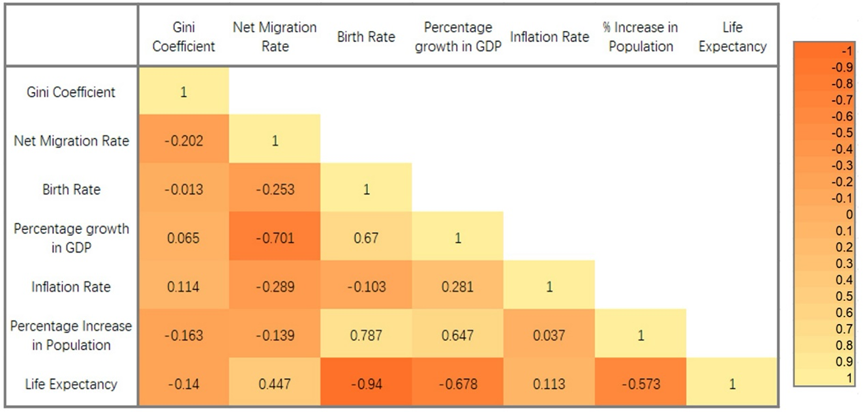
This article aims to identify factors that influences income inequality and the method of multiple linear regression is used. The Gini coefficient is employed to measure the degree of income inequality, and multiple variables such as demographic trends, population health, and economic indicators are selected. Through regression analyses of data from China from 2001 to 2020 and data from 30 developed countries in 2020, it is found that in the Chinese model, multiple variables are closely related to the Gini coefficient, with a relatively high level of fitting. In the international model, only the net migration rate has a significant impact on the Gini coefficient, with a lower fitting than the Chinese model. This indicates that there are differences in the factors influencing income inequality between China and developed countries. What holds true for China may not be applicable to the international context, and vice versa. In the Chinese model, the combined effect of variables is more prominent, while in developed countries, the influences of other considered factors are likely to be more prominent.