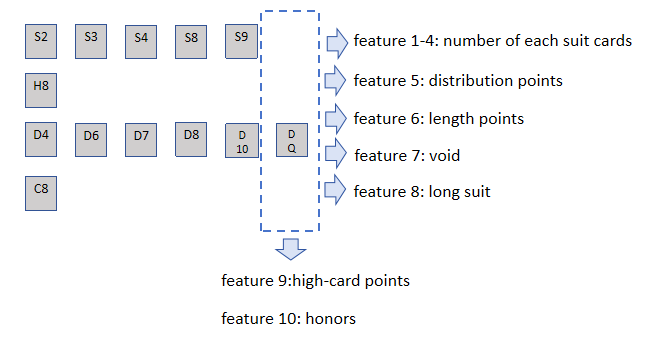
With the successful application of Artificial intelligence (AI) technology in a range of information intelligence projects similar to bridge, a more scientifically rigorous new field has been opened by studying the logic of AI technology. AI has demonstrated the ability to challenge human intelligence projects such as bridge. This study focuses on the bidding system of bridge, obtains real simulated data of bridge bidding, combines basic card features with artificially constructed features, and analyzes the key issues faced by bidding research. A neural network structure based on Deep Q-Network (DQN) is proposed to find a suitable neural network structure for bidding game research. Through the comparison of testing costs and total bidding times, as well as the analysis of feature ablation experiments, it is found that different features have different impacts on the machine learning model performance of the bridge bidding system. Features such as "number of each suit cards," "high-card points," and "honors" have a positive effect on the model performance, while other features have limited impact on the model performance. The application of Deep Learning methods in bridge bidding algorithm research contributes to the advancement of machine gaming and AI industries.