Articles in this Volume

Research Article Open Access
A Natural Gradient Descent Algorithm of Importance Sampling
Importance Sampling (IS) is a fundamental variance reduction technique in Monte Carlo simulation, particularly for estimating rare event probabilities. Its core idea is to find a better sampling measureℚunder which the target events occur more frequently, to reduce the cost of simulation of rare events. However, determining such an optimalℚis notoriously difficult, often leading to complicated partial differential equations (PDE) that many classical methods fail. This paper aims to introduce a novel geometric perspective of this optimization problem that we consider all proper likelihood ratios as a manifold, and use the natural gradient property to design the algorithm, which avoids PDE and outperforms the ordinary stochastic gradient descent (SGD) algorithm. Under standard regularity and Novikov conditions, we establish the almost sure convergence of the proposed algorithm utilizing the Robbins-Siegmund theorem and end up with numerical validation on option pricing and portfolio risk assessment, confirming that the geometric approach significantly enhances variance reduction efficiency.
Show more
Read Article PDF
Cite
Research Article Open Access
Monte Carlo Method for Estimating the Area of Irregular Shapes
In daily life, there is a practical demand for area estimation of irregular graphics in scenarios such as leaf area measurement, map jurisdiction area calculation, and art design graphic area estimation. Among traditional estimation methods, the grid method is cumbersome to operate, the formula method is only applicable to regular graphics, and instrument measurement has high costs, which makes it difficult to meet the low-cost and easy-to-operate estimation needs. This study aims to verify the feasibility of the Monte Carlo method in estimating the area of irregular graphics and analyze the key factors affecting the estimation accuracy. This study combines manual simulation and Python programming simulation, uses the control variable method to compare the estimation results under different experimental conditions, and selects three typical irregular graphics: sycamore leaves, hand-drawn cartoon avatars, and the map jurisdiction of Yuelu District, Changsha City for experiments. The results show that the Monte Carlo method is suitable for area estimation of any irregular graphics, the estimation accuracy improves with the increase of the number of points, the error can be controlled within 2% when 10,000 points are cast, and the programming simulation accuracy is significantly higher than manual simulation, with the error rate 3%-5% lower than manual simulation. This study provides a simple and feasible area estimation scheme for irregular graphics for high school students, realizes the combination of probability knowledge and practical application, and provides an interdisciplinary (mathematics + programming) practical case.
Show more
Read Article PDF
Cite
Research Article Open Access
Mathematical Modeling and Vibration Reduction Performance Analysis of the Cable-NES System
Article thumbnail
This paper mainly discusses the application potential of NES in vibration reduction of stay cables. By establishing a mathematical model of the combined stay cable and NES system, it derives the motion equations based on Hamilton's principle, so as to analyze the dynamic characteristics of the coupled system. On this basis, numerical simulation methods are adopted to explore the vibration reduction effect of NES under different excitation conditions. The research results show that compared with traditional vibration reduction devices, NES exhibits superior vibration reduction performance in a wide frequency domain, especially in suppressing the main resonance peak, and has stronger adaptability and response capability. Through amplitude-frequency response analysis and random response analysis, this paper reveals the important role of NES in reducing the amplitude of stay cables, improving structural stability and prolonging service life. In addition, this paper evaluates the feasibility and design optimization potential of NES in practical engineering applications, and emphasizes its wide adaptability in complex dynamic environments.
Show more
Read Article PDF
Cite
Research Article Open Access
Comparison of Efficient Path Generation and Variance Reduction Strategies in Asian Option Pricing: Based on Sobol Sequences and Control Variates
Article thumbnail
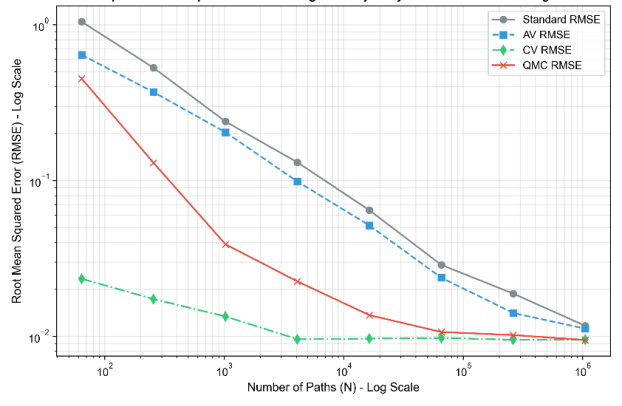
Monte Carlo (MC) simulation is the predominant numerical method for pricing path-dependent derivatives, such as arithmetic average Asian options, which lack closed-form solutions. However, its slow convergence rate,O(1N), requires large computational budgets. This paper investigates and quantitatively compares two primary strategies for enhancing MC efficiency: Variance Reduction (VR) techniques, specifically Antithetic Variates (AV) and Control Variates (CV), and Efficient Path Generation using Quasi-Monte Carlo (QMC) methods with Sobol sequences. It benchmarks the performance of Standard MC, AV, CV (using the geometric Asian option as the control variable), and Sobol QMC using a comprehensive set of performance metrics: Variance Reduction Ratios (VRR), Root Mean Square Error (RMSE) convergence rates, and computational time efficiency. The results demonstrate that, while CV offers the highest VRR, the Sobol QMC method consistently achieves the fastest convergence rate towards the true value across varying levels of path complexity, providing superior efficiency, especially when high precision is required. This study offers practical guidance for financial engineers in selecting the optimal simulation acceleration technique based on their specific accuracy and computational budget constraints.
Show more
Read Article PDF
Cite
Research Article Open Access
Maze Generation and Structural Simplification for Maze Solving: A Graph Theoretical Viewpoint
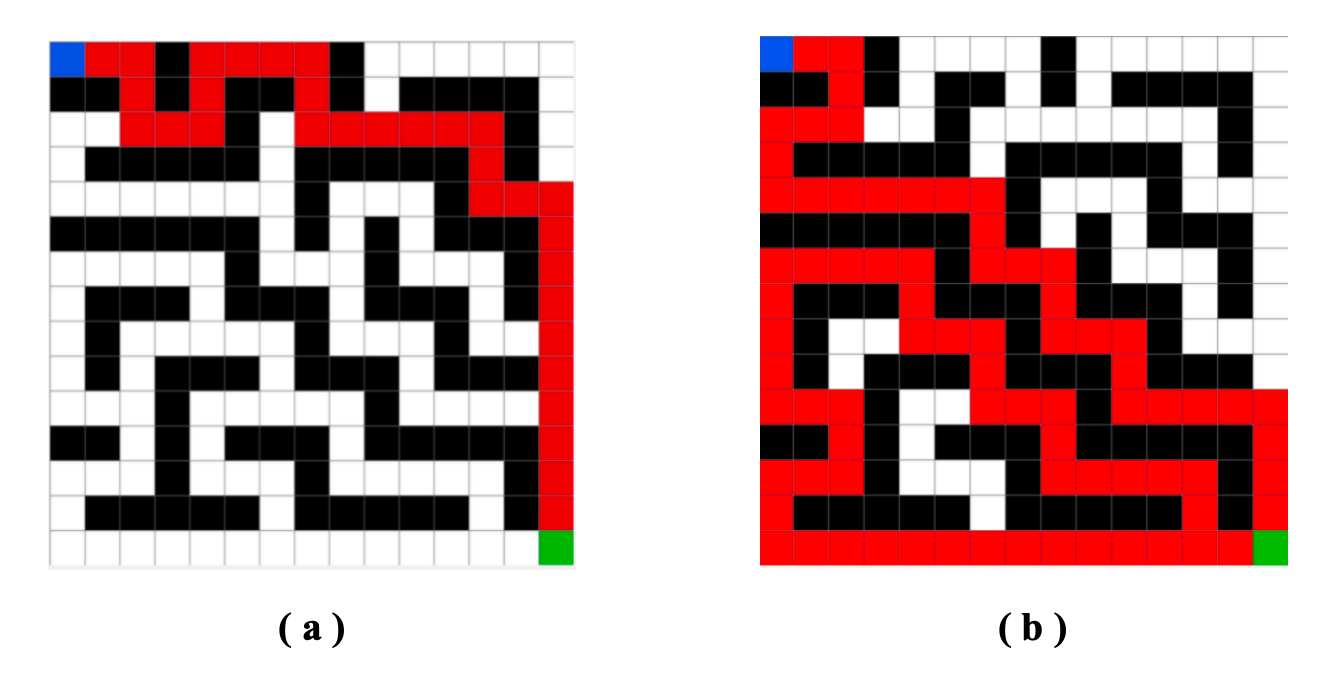
Maze generation and maze solving are two well-known issues in computer science. At first glance they seem to be easy puzzles, but in fact, they involve many concepts from graph theory and algorithm design. This paper introduces some common methods for maze generation, such as Binary Tree algorithm, Recursive Backtracking and the Aldous–Broder algorithm. These methods generate mazes in various ways, thus the final structures of the mazes differ in terms of randomness, bias and complexity. Concerning maze solving, traditional search methods like Breadth-First Search (BFS) and Depth-First Search (DFS) are briefly mentioned. However, the main attention is paid to the Dead-End Filling algorithm. Unlike BFS or DFS, the Dead-End Filling does not search for a direct path. It eliminates the dead ends step by step until the remaining part shows the solution path. From a graph viewpoint, this procedure can be considered as simplifying the graph structure instead of exploring possible routes. The discussion indicates that the method used for generating a maze has an important effect on its solving way. This is particularly obvious for the reduction-based methods like Dead-End Filling, since their performance depends largely on the distribution of dead ends in the maze. In perfect mazes, where the maze structure is equivalent to a spanning tree, the Dead-End Filling works most effectively. In summary, this paper reviews several typical generation and solving methods and expounds their connections from a graph-theoretical perspective.
Show more
Read Article PDF
Cite
Research Article Open Access
Comparative Performance Analysis of BFS and Left-Hand Rule Algorithms for Autonomous Maze Navigation in OCaml
Article thumbnail
Compare the Performance of Global and Local Navigation Paradigms in Autonomous Spatial Path Planning in this Study. The first purpose is to explore the efficiency of algorithms, memory scaling and structure robustness for discrete maze-solving agents built in functional programming languages. Mechanistically, in this way, binary weights are used to convert a continuous environment into a structured two-dimensional grid matrix, the starting coordinate of the entrance is fixed at the lower-right corner, and the target destination is placed on the upper-left boundary of the exit. The two frameworks for modelling path planning are as follows: First, a state-exhaustive Breadth-First Search (BFS) tracking model is employed to use a first-in, first-out queue and a boolean tracking matrix for uniform radial, layer-by-layer exploration; second, a localized Left-Hand Rule algorithm is used, which is structured as a memoryless Finite State Machine that executes a deterministic relative turning priority queue based on real-time directional vectors, prioritising relative left turns and straight movements over relative right turns and backward turnarounds. Benchmarking in OCaml shows that BFS ensures the shortest path by exploring uniformly outwards but is space-intensive; the Left-Hand Rule is very memory-efficient but may lead to non-optimal routing or cyclic deadlocks in multiply connected topologies. BFS is very suitable for resource-intensive applications that require high precision in the end, and the Left-Hand Rule provides an efficient and light-weight paradigm only for simply connected geometric boundaries.
Show more
Read Article PDF
Cite
Research Article Open Access
An Investigation on Reinforcement Learning Approaches to Maze Solving
The problem of moving from a starting point to a destination through a maze of walls and passages, known as maze solving, has been an active field of research in mathematics and computer science for decades with applications to robotics, logistics, network routing and game AI. Classical search algorithms such as Depth First Search (DFS), Breadth First Search (BFS) and A* provide deterministic guarantees but require complete prior knowledge of the environment and fail in dynamic or partially observable settings. Reinforcement learning (RL) provides a completely different paradigm. Agents learn the optimal navigation strategy through trial and error interaction, without relying on predefined maps. This paper summarizes the maze solving methods based on RL. The research methods mainly include seven categories: Deep Q-Networks, Quantum Reinforcement Learning(QRL), Hierarchical RL, Curriculum Learning, Reward Shaping, Transfer Learning, and Multi-Agent RL. Each category has representative works, potential mechanisms and experimental results. Then the sample efficiency, scalability, observability requirements and applicability are compared to determine three urgent challenges: sample efficiency in large-scale maze, partial observability and processing of dynamic environment, and the gap between simulation and reality. The purpose of this survey is to provide researchers with a systematic understanding of the current landscape and determine the direction of future work.
Show more
Read Article PDF
Cite
Research Article Open Access
From Traditional Search Techniques to Deep Reinforcement Learning: Intelligent Navigation Approaches
Navigation Intelligence is one of the problems in Artificial Intelligence, Robotics and Autonomous Platforms. It is a system that needs to go from a start to an end, avoiding obstacles and selecting an optimal path. This paper studies typical navigation techniques and how they operate. The traditional ways explored here are Breadth-First Search, Depth-First Search, Dijkstra's algorithm and A*. The first way is simple to use and stable in a relatively good and simple environment; however, it is not very convenient for many cases. At the same time, the frameworks of reinforcement learning and deep reinforcement learning, such as Q-learning, Deep Q-Networks, Proximal Policy Optimisation and Asynchronous Advantage Actor-Critic, can be employed to learn the movement pattern of an agent through interaction with its environment. The above ways are relatively more flexible in the area that is difficult to reach or only partially known. However, they also have some limitations. That is to say, the training costs are high, the results are inconsistent, and they cannot respond to new situations quickly. According to the results of the survey, in the future, intelligent navigation architecture may be combined with traditional planning technology.
Show more
Read Article PDF
Cite