
Articles in this Volume

Research Article Open Access
ApoE4-Driven Neurodegeneration in Alzheimer’s Disease: From Brain Atrophy to Inhibitory Neuron Loss
Article thumbnail
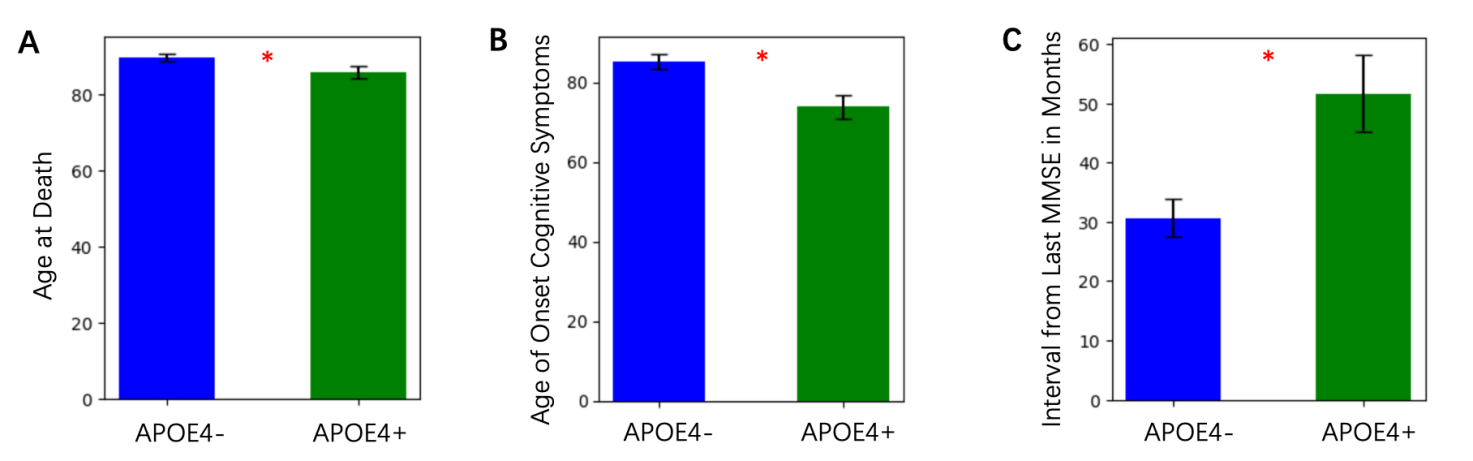
Alzheimer’s disease (AD) is a progressive neurodegenerative disorder characterized by cognitive decline, amyloid plaque accumulation, and tau pathology. The Apolipoprotein E4 (ApoE4) allele is the strongest genetic risk factor for late-onset AD, contributing to increased amyloid burden, neuroinflammation, and brain atrophy. However, the cellular and structural mechanisms underlying ApoE4’s impact on disease progression remain incompletely understood. In this paper, we analyzed multi-modal datasets from the Seattle Alzheimer’s Disease Brain Cell Atlas (SEA-AD) to investigate differences between ApoE4+ and ApoE4- individuals. 116 parameters were assessed, including neuropathology, imaging, and clinical outcomes and we identified 15 key parameters that are more significant and representative between the groups. ApoE4+ individuals exhibited earlier cognitive decline, greater tau and amyloid pathology, and accelerated brain atrophy, particularly in cortical and subcortical regions. RNA sequencing of the Prefrontal Cortex (PFC) and Middle Temporal Gyrus (MTG) revealed significant reductions in Sst Chodl, Sncg, and Vip interneurons in ApoE4+ individuals. These findings suggest that ApoE4 carriers experience widespread neurodegenerative changes, including altered inhibitory neuron composition, which may contribute to disease progression. Understanding how ApoE4 affects inhibitory networks could provide new insights into Alzheimer’s pathology and potential therapeutic targets.
Show more
Read Article PDF
Cite
Research Article Open Access
The Connection Between Dairy Consumption and Inflammatory Stress: A Comprehensive Review
Emerging studies challenge the popular view that dairy products unanimously promote inflammation. This review synthesizes current research on how variations in fermentation status and fat content influence the inflammatory potential of dairy. Through enrichment with probiotics and postbiotics, fermented dairy products demonstrate dual regulatory effects: modulating gut microbiota composition while suppressing pro-inflammatory signaling pathways. Conversely, non-fermented and high-fat dairy products exhibit heterogeneous inflammatory responses—particularly among individuals with metabolic dysfunction—where outcomes range from neutral to markedly pro-inflammatory. The inconsistencies arise from variations in bacteria strains, fat composition, processing methods, and host metabolic status. This review underscores the need for more standardized interventions and broader participant diversity in the future to clarify dairy’s role in inflammation.
Show more
Read Article PDF
Cite
Research Article Open Access
Advances in the Causality, Diagnosis and Management of Erectile Dysfunction
Penile erection demonstrates how psychological influences and hormonal balance modulate microcirculation. It results from a highly coordinated neurovascular process involving the integration and synchronisation of vascular endothelium, smooth muscle, and psychological, neurological, and endocrine systems. Therefore, the proper functioning of these processes is essential for maintaining penile flaccidity or achieving an erection, whereas disturbances in any component can result in erectile dysfunction (ED). ED is a common health condition with a substantial impact on men’s quality of life worldwide. Currently, this disease is considered a multifactorial condition involving a complex interplay of social, psychological, and physiological factors, necessitating the adoption of multiple treatment strategies. This paper offers an overview of the mechanisms of erections, etiological factors contributing to ED—including psychological, neurological, endocrinological, and vasculogenic aspects—diagnostic approaches and treatments.
Show more
Read Article PDF
Cite
Research Article Open Access
The Digital Trio Revolutionizing Oral Restoration: A Review on Intraoral Scanning, 3D Printing, and Artificial Intelligence
With the continuous development of the digitalization process in oral medicine, digital oral scanning, 3D printing and artificial intelligence technologies are gradually integrating and driving the transformation of the diagnostic model in oral restoration. This article, through systematic literature retrieval and analysis, integrates recent domestic and international research findings and clinical data on relevant digital technologies in the field of oral restoration, and explores the characteristics and applications of these three technologies in oral restoration. The results show that digital oral scanning can improve the accuracy of impression taking and clinical efficiency, 3D printing realizes the efficient personalized manufacturing of restorations, and AI technology can further optimize the design.
Show more
Read Article PDF
Cite
Research Article Open Access
The Application of Mediterranean Diet in Common Diseases during Adolescence
Adolescence marks a phase of drastic physiological and psychological transformations in individuals, characterized by the development of secondary sexual characteristics, significant hormone fluctuations, a heightened sense of independence, and shifts in social roles. This period is often plagued by health issues such as acne, obesity, and depression, which can profoundly impact adolescents' quality of life and future prospects. Given the potential drawbacks of traditional pharmacological treatments, including side effects, poor adherence, and high costs, it is imperative to seek out safe, effective, and easily incorporable supplementary or preventive strategies for daily life. This article delves into the mechanisms and clinical evidence supporting the Mediterranean diet pattern (centered around olive oil, fruits, vegetables, whole grains, and fish) in mitigating acne severity, tackling obesity and its metabolic complications, and alleviating depressive symptoms. Research has shown that the Mediterranean diet exerts a synergistic protective effect on common adolescent ailments through various pathways, including modulating the insulin/IGF-1 signaling pathway, enhancing lipid metabolism, decreasing systemic chronic inflammation, and optimizing gut microbiota composition. Moreover, it encapsulates the essence of sustainable healthy living and offers a pivotal pathway for the comprehensive management of adolescent conditions.
Show more
Read Article PDF
Cite
Research Article Open Access
Phage Therapy: An Emerging Strategy against Drug-Resistant Bacteria and Future Perspectives
The widespread use of antimicrobial agents has led to the increasingly severe global problem of drug resistance. Multidrug-resistant bacteria and even "superbugs" threaten human health, making the development of new antibacterial approaches extremely urgent. Against this backdrop, phage therapy has attracted much attention as an emerging strategy. From both historical and empirical standpoints, this paper examines the devastation wrought by unchecked Yersinia pestis during the Black Death. It proceeds to dissect the mechanisms of drug resistance in Gram-negative bacteria, elucidate the bactericidal action of phages, and introduce therapeutic strategies employing single phages, phage cocktails, and genetically modified phages. It lists successful cases to demonstrate the application effects of phage therapy. The analysis highlights the advantages of phage therapy in precise bactericidal action, low immunogenicity, etc.. It points out its challenges in large-scale production, regulation, bacterial drug resistance, and clinical cognition. Phage therapy can potentially combat drug-resistant bacteria, but it needs to overcome existing challenges. In the future, in-depth research should be carried out from optimizing production and improving regulation to promote its development.
Show more
Read Article PDF
Cite
Research Article Open Access
A Comparative Literature Review of "Stroke 120" and "FAST" in China’s Stroke Emergency Education
Stroke remains one of the major causes of death and disability in China. Pre-hospital delay is a key obstacle hindering timely treatment. Therefore, the effectiveness of stroke education tools is particularly important. Through a systematic literature review, this article compared and analyzed the actual application effects of the internationally recognized stroke identification tool "FAST" and the Chinese-ized identification tool "Stroke 120" in public education and behavioral intervention. Although both have highly consistent structural designs and core goals, existing empirical studies have shown that "Stroke 120" has a more significant intervention effect in terms of public recognition rate and the use of emergency services. This advantage is mainly attributed to its high local fit in language structure and cultural memory patterns. However, current related research still has limitations such as the lack of randomized controlled trials, insufficient samples from rural areas, and lax control of demographics. This article emphasizes the significance of the localization of health education tools in terms of communication efficiency and behavioral transformation and suggests promoting "Stroke 120" nationwide, strengthening the scientificity and comprehensiveness of the intervention mechanisms, and conducting more comparative studies to optimize the evidence-based foundation of China's stroke emergency education system.
Show more
Read Article PDF
Cite
Research Article Open Access
Study on the Efficacy Duration and Mechanism of Key Ingredients in Acne-Fighting Cosmetics
This study systematically analyzed five common acne-fighting ingredients, investigating their mechanisms of action, onset times, and side effects. The subjects included salicylic acid, benzoyl peroxide, tea tree oil, sulfur, and retinol. Results were derived through literature review and data synthesis. Findings indicate these ingredients exhibit differences in anti-inflammatory, antibacterial, keratolytic, and sebum-regulating properties, with varying efficacy and onset times. Salicylic acid acts rapidly with low irritation, benzoyl peroxide demonstrates the strongest antibacterial activity, tea tree oil is suitable for sensitive skin, while sulfur and retinol show significant efficacy in deep sebum regulation. Limitations include the absence of long-term clinical data and insufficient consideration of individual skin type variations. Future research may explore ingredient combinations, personalized skin type studies, clinical trials, novel drug development, or systemic optimization of current acne treatment strategies. These findings not only guide acne ingredient selection and personalized care but also establish a scientific foundation for new formulation development.
Show more
Read Article PDF
Cite
Research Article Open Access
Exploring the Treatment of Insomnia in Traditional Chinese Medicine from the Perspective of Yin-Yang Deficiency and Excess
This study aims to explore effective approaches and methods of treating insomnia in Traditional Chinese Medicine (TCM) through the theoretical framework of Yin–Yang deficiency and excess. By conducting a comprehensive literature review, it systematically examines the intrinsic connection between the Yin–Yang theory and insomnia, as well as the treatment strategies in TCM derived from this framework. In addition, clinical case analyses are employed to further verify the practical efficacy of these theoretical applications. The findings indicate that the Yin–Yang deficiency–excess theory plays a pivotal role in TCM approaches to insomnia. It not only provides a solid theoretical basis for syndrome differentiation and treatment but also demonstrates that therapeutic methods grounded in this theory—such as herbal prescriptions, acupuncture, and massage—yield remarkable clinical efficacy. These interventions offer safe and effective therapeutic options for patients with insomnia, highlighting the unique advantages and significant value of TCM in this field.
Show more
Read Article PDF
Cite
Research Article Open Access
Exploration of the Mechanism of Action of Immune Checkpoint Inhibitors and Their Advancements in Cancer Immunotherapy
Immune checkpoint inhibitors (ICIs), which target novel immune receptors including programmed cell death protein-1 (PD-1), cytotoxic T-lymphocyte-associated antigen-4 (CTLA-4), lymphocyte activation gene-3 (LAG-3), T-cell immunoglobulin and ITIM domain (TIGIT), and T-cell immunoglobulin and mucin domain 3 (TIM-3), have profoundly reshaped cancer treatment paradigms. Tumors exploit these signaling pathways to suppress T-cell activation and impair immune surveillance. By interrupting inhibitory signaling, ICIs mechanistically restore antitumor immune responses. In clinical practice, ICIs have demonstrated durable efficacy and wide-ranging applicability across multiple solid tumors, markedly increasing overall survival (OS) when utilized as monotherapy or in combination with chemotherapy or anti-angiogenic therapies. Nonetheless, significant clinical challenges persist, including heterogeneous patient responses, only approximately 20–40% achieve sustained remission, and immune-related adverse events (irAEs) affecting around 50–70% of recipients. Additionally, existing biomarkers, such as programmed cell death-ligand 1 (PD-L1) expression levels and tumor mutation burden, exhibit limited predictive accuracy across different cancer types. Moreover, irAEs, including severe pneumonitis and endocrine toxicities, require specialized clinical management. Moving forward, research should emphasize developing multi-omics-based biomarkers, refining combination treatment regimens, and unraveling resistance mechanisms to improve the precision and effectiveness of immunotherapy.
Show more
Read Article PDF
Cite