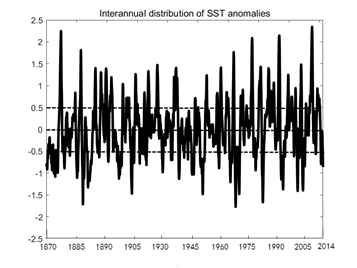
The Atlantic Meridional Overturning Circulation (AMOC) is a vital component of the global climate system, playing a crucial role in transporting heat and salinity from the equator to the North Atlantic, which in turn keeps Europe significantly warmer than other regions at the same latitude. Despite the fact that long-term observations and models have demonstrated an AMOC slowdown in response to global warming since the industrial revolution, detecting this slowdown in the brief observational record has proven to be challenging. In this study, the author investigates the relationship between short-term variability and the weakening AMOC by analyzing satellite remote sensing data of sea surface salinity collected over a decade. As a consequence of global warming, the weakened AMOC transports less heat and salt from the equator to sub-polar regions, causing heat and salt anomalies. This evidence further corroborates the slowing of the AMOC in response to human-caused warming and emphasizes the variability on a scale of half a decade caused by the deceleration.