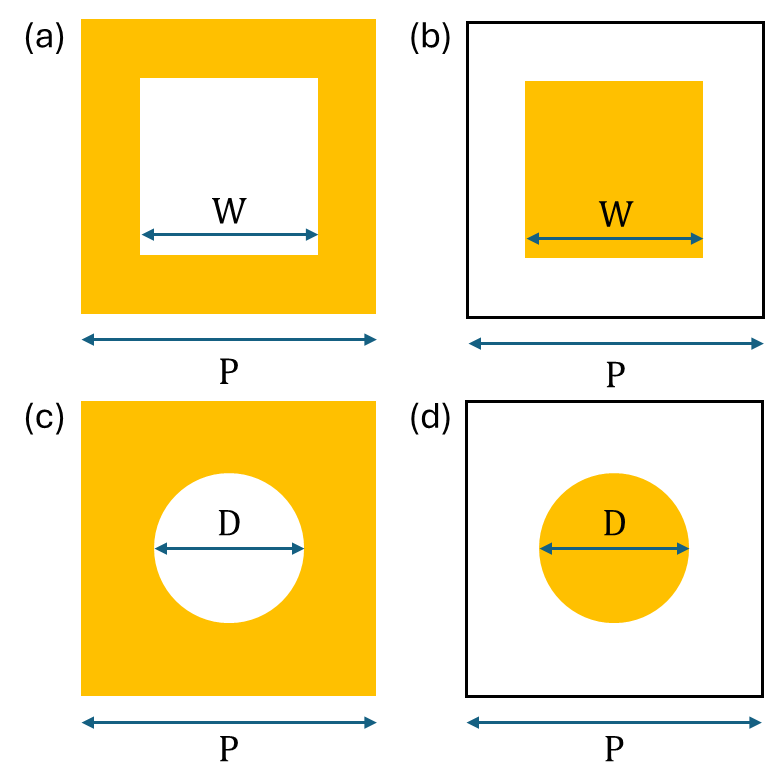
Metal meshes are commonly used as reflective elements in far infrared astronomical instruments, where spectrally uniform reflectivity is important for stable Fabry–Perot interferometer performance and reliable calibration. In this work, we quantitatively compare the spectral reflectivity uniformity of representative metal mesh geometries using full wave electromagnetic simulations. Square and circular meshes with inductive and capacitive topologies are analyzed over the 200 to 400 GHz band. A figure of merit based on the normalized root mean square deviation of reflectance from a target value is used to evaluate spectral flatness. Parameter sweeps over lattice pitch and normalized feature size reveal well defined regions that minimize spectral variation. All four geometries can achieve comparable reflectivity uniformity when properly optimized, with square inductive meshes yielding the lowest figure of merit within the explored design space. The results provide practical guidance for selecting metal mesh geometries with flat reflectance profiles in far infrared Fabry–Perot interferometers and related optical systems.