Articles in this Volume

Research Article Open Access
Music and Concentration: Behavioral and Contextual Predictors in Adolescents
Article thumbnail
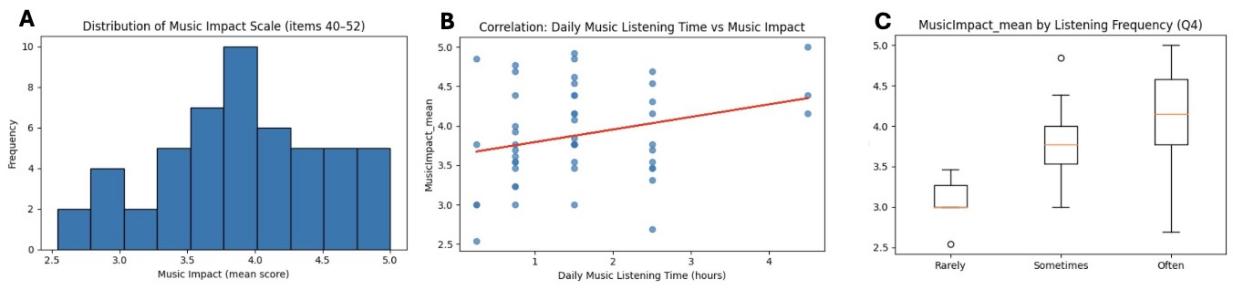
In modern society, background music is often used as a tool to promote learning during the learning process, but in fact, there is still widespread controversy over the effect of music. The present study investigates how music is perceived to influence concentration, with a focus on influential factors and text types. Fifty-one participants completed an anonymous questionnaire assessing music-listening behaviors, music preferences, and perceived effects of music on concentration and task performance. By using composite indices, the data shows that music can facilitate individuals' concentration overall and are influenced by music elements and text types; in contrast, the interference caused by music on attention are mainly determined by individuals' differentiation. These findings suggest that music functions depend more on how it is used and the task context than on specific musical characteristics and provide adolescents referenceable data for the use of music.
Show more
Read Article PDF
Cite
Research Article Open Access
Mechanism of Action and Clinical Effectiveness of Bacterial Lysates in Preventing Acute Exacerbations of Chronic Obstructive Pulmonary Disease
Chronic obstructive pulmonary disease (COPD) is the third leading cause of death worldwide, and its prevalence continues to increase. Acute exacerbation (AECOPD) is a critical step in the progression of the disease, leading to irreversible decline in lung function. Among existing preventive measures, inhaled bronchodilators only alleviate symptoms and fail to reduce the risk of infection-related exacerbations. Vaccines do not cover multiple pathogens, and prophylactic antibiotics are prone to inducing drug resistance, all with obvious limitations. This study reviews the immunomodulatory mechanisms and clinical efficacy of bacterial lysates. High-quality literature from 2020 to 2025 was selected for qualitative and comprehensive analysis. The aim is to clarify the core mechanism of action and clinical efficacy of these lysates in preventing AECOPD, and to provide evidence-based support for clinical practice. The reviewed studies demonstrate that bacterial lysates can significantly reduce the incidence and hospital admission rate of AECOPD by synergistically regulating innate and adaptive immunity and strengthening the respiratory mucosal barrier, thereby reducing antibiotic use. They also have favorable safety and tolerability, providing evidence-based support for clinical practice and are expected to become an important means of AECOPD prevention.
Show more
Read Article PDF
Cite