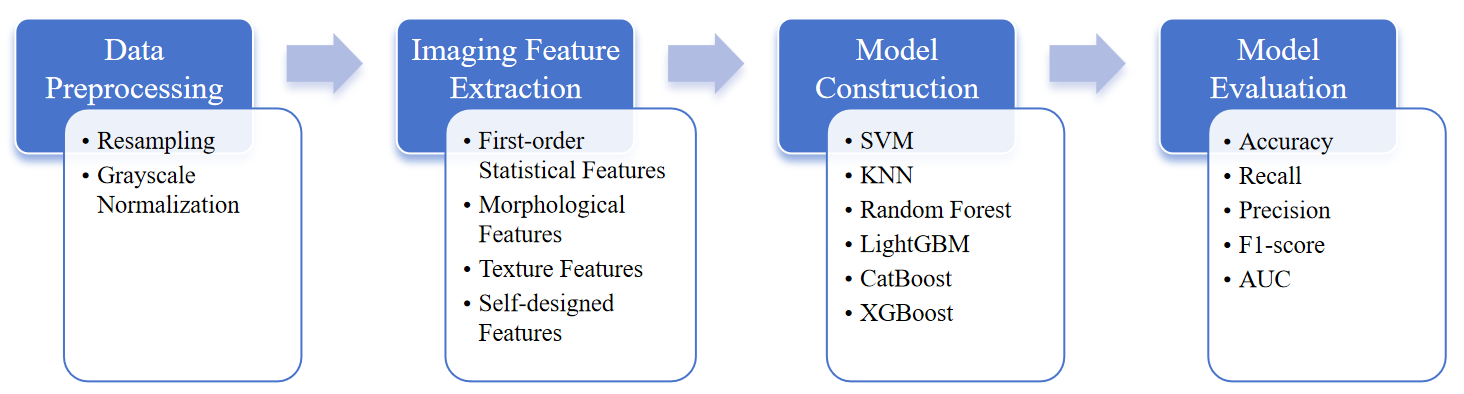
This study aims to improve the accuracy of breast cancer diagnosis by constructing a binary classification model through machine learning-based extraction of radiomic features from breast ultrasound images. A total of 780 breast ultrasound images from 600 female patients aged 25–75 years were selected and divided into "diseased" and "non-diseased" groups. Features including first-order statistics, morphological characteristics, texture parameters, and a self-created concentric grey-level fitting curve slope feature were extracted. Six classifiers, including SVM and KNN, were used to construct models, which were evaluated using ten-fold stratified cross-validation. Results showed that model performance improved across all approaches when incorporating the self-created feature. Notably, the LightGBM model exhibited enhanced discriminatory capability, with AUC increasing from 0.683 to 0.715. This indicates that machine learning-based radiomics feature extraction can effectively support breast cancer diagnosis.