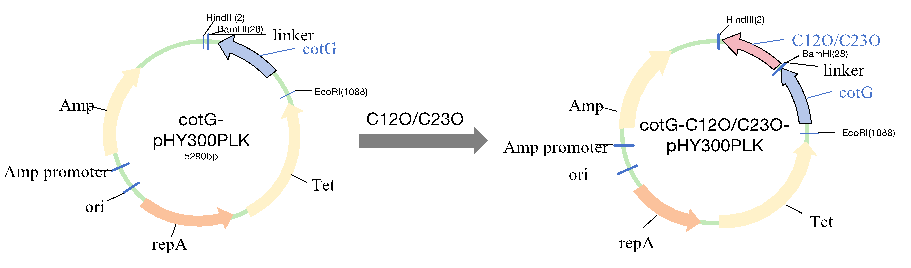
Catechol is a pollutant commonly found in industrial and everyday wastewater, with genotoxic effects that can lead to mutations, DNA fragmentation, and chromosomal aberrations. Traditional physical and chemical degradation methods face challenges such as high costs and secondary pollution, whereas biological degradation offers a cost-effective and environmentally friendly alternative. This study investigates the use of the Bacillus subtilis spore surface display system for catechol degradation, aiming to develop an efficient, low-cost biodegradation method. Recombinant Bacillus subtilis was successfully engineered to display catechol 1,2-dioxygenase (C12O) and catechol 2,3-dioxygenase (C23O) on the spore surface. Immunoblotting and immunofluorescence confirmed protein display and enzyme activity assays demonstrated catechol degradation activity. The displayed enzymes showed stability across a wide pH and temperature range, maintaining activity even under methanol conditions. Compared to purified proteins, the spore-bound enzymes eliminated purification steps, reducing costs and improving degradation efficiency in some conditions. These results suggest that the Bacillus subtilis spore display system has great potential in biocatalysis, offering a novel strategy for environmental pollution remediation.