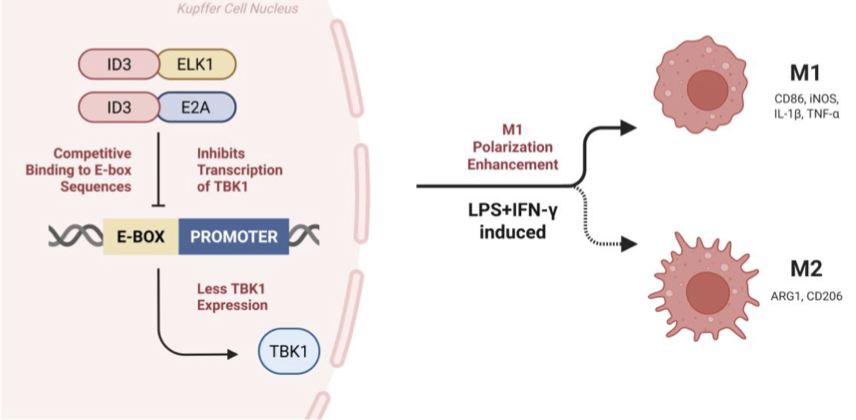
Cancer is a globally significant disease, which caused 9.7 million related deaths worldwide in 2022 alone. The tumor microenvironment (TME) represents a major barrier to effective cancer treatment, as it can promote tumor immune evasion and reduce the efficacy of anticancer therapies. Macrophage polarization is also a key determinant of tumor progression: by modulating the shift of macrophages between the M1 and M2 phenotypes, the body can modulate anti-tumor functions. This study aims to elucidate how the ID3–E2A/ELK1 complex modulates TBK1 expression to drive M1 macrophage polarization. We propose that this complex binds the TBK1 promoter, repressing its expression and subsequently promoting IRF5 activation, which shifts macrophages toward an M1 phenotype. Through genetic and functional assays, we propose to further explore how ID3-mediated TBK1 inhibition enhances phagocytosis and antitumor immunity. These insights may guide future development of macrophage-targeted immunotherapies for cancer treatment.