Articles in this Volume

Research Article Open Access
Research on the Mechanism of Huangqi Polysaccharides in Cervical Cancer
Cervical cancer is an important malignancy threatening the health of women that has been extensively studied lately due to its impressive anti-tumor and immunomodulatory experiences. Astragalus Polysaccharide (APS), also the primary active constituent of the traditional Chinese medicine Astragalus, is generally gaining immense attention because of its impressive anti-tumor and immunomodulatory properties. As part of the immune system APS both regulates the immune response and directly kills tumor cells: it triggers tumor cell apoptosis and remodels the immune microenvironment to augment the immune response, thereby complementing each other in fighting the tumor. Also, it can affect ERS signaling pathway and enable the reversal of epithelial-mesenchymal transition (EMT) process, inhibition of tumor invasion and metastasis, as well as the increase of the sensitivity of chemotherapy drugs. This paper examines the mechanism of synergy of APS in directly killing tumor cells, multifaceted immune control, and chemosensitization, which have the great potential to help in an adjunct therapy of cervical cancer, provides a theoretical background of development of the new treatment methods, as well states the single shortcoming of clinical application due to the absence of standardized portocol.
Show more
Read Article PDF
Cite
Research Article Open Access
The Toxicological Mechanisms of Microplastics in Aquatic and Mammalian Animals
Microplastics, as global environmental pollutants, have been widely distributed in water bodies, soil and the food chain. The ingestion of microplastics can induce a series of continuous toxicological effects in organisms. However, existing research mostly focuses on a single biological group and lacks a systematic summary of the commonalities and differences in toxicological mechanisms among different species. This review aims to summarize the toxicological pathways of microplastics in aquatic organisms and mammals, with a focus on discussing the similarities and differences in their toxicological effects ranging from oxidative stress, inflammatory responses to energy metabolism disorders. According to the research in this article, the overall process of toxicological effects of microplastics in different organisms has cross-species commonalities. However, aquatic organisms are more prone to acute, high-intensity, and irreversible tissue damage, while mammals show chronic, controllable inflammatory responses and systemic energy metabolism inhibition across organs. This review can provide an important reference for a deeper understanding of the toxicity of microplastics and for improving the health risk assessment system.
Show more
Read Article PDF
Cite
Research Article Open Access
Functional Regulation of NK Cells in the Tumor Microenvironment: A Metabolic Perspective
Natural Killer (NK) cells are the core effector cells in anti-tumor immunity, with the primary function of directly killing tumor cells and initiating subsequent immune responses. Compared with CAR-T and CD8+ T cells, NK cells have more prominent advantages in the treatment of solid tumors. However, metabolic abnormalities in the tumor microenvironment (TME) can lead to their functional exhaustion, thereby limiting the therapeutic effect on solid tumors. Existing reviews mostly focus on the basic mechanisms or clinical applications of NK cells, lacking a systematic overview of the research progress on how TME metabolism regulates NK cell function from a metabolic perspective. In particular, there is a lack of comprehensive analysis of the key nodes and targeted strategies of metabolic abnormalities driving NK cell functional exhaustion. This review, through literature analysis, systematically reviews the key research nodes of TME metabolism regulating NK cell function from 1975 to 2025, the core mechanisms of TME metabolic abnormalities regulating NK cell function, targeted therapeutic strategies in this field, and the current research limitations etc. It aims to build a knowledge framework from a metabolic perspective for researchers in this field and provide a theoretical basis and research directions for optimizing NK cell-targeted immunotherapy.
Show more
Read Article PDF
Cite
Research Article Open Access
The Pharmacological Mechanism and Clinical Application of Aspirin
The history of aspirin development follows a systematic drug research route, starting with the natural medicinal use of willow bark and culminating in the synthesis of acetylsalicylic acid in 1897, leading to a theoretical understanding of its action in blocking cyclooxygenase (COX) by 1971. The majority of its mechanisms are blocking the synthesis of prostaglandins by permanently acetylating the serine residues of COX-1/COX-2. It also prevents the platelet aggregation even in low doses. Clinically, it is frequently employed due to its effective use as an agent against mild/moderate inflammation, moderate pain, and fever; cardiovascular and cerebrovascular diseases; the risk of colorectal and gastric cancer; and Alzheimer's disease. Some of the safety risks are gastrointestinal damage, asthma caused by the use of aspirin, and hemorrhage during pregnancy. Choose enteric-coated preparations first, monitor the delivery of low-dose preparations, screen high-risk groups, and conduct clinical screening. In the future, having incorporated precision medicine, targeted delivery, and artificial intelligence technologies, aspirin has the potential to undergo personalization in both the prevention and treatment of tumors and neurodegenerative diseases, so its clinical potential continues to grow.
Show more
Read Article PDF
Cite
Research Article Open Access
Role of Targeted Nanocarriers in Cancer Therapy
Due to the problems like not being specific enough for targets, having lots of toxic side effects, and the growth of resistance to medicine, traditional ways of treating cancer don't work very well. The appearance of targeted nanocarriers gives a major approach to beating these difficulties. These carriers accomplish exact drug delivery via a dual-targeting mechanism. And the passive targeting is mostly to improve the permeability of the vessel, and keep it, when you adjust the particle size that it can enter the gap of the tumor's blood vessel, plus ultrasonic physical method and other magnetic fields, the exact rate of the tumor can be achieved more. Active targeting is carried out by grafting specific ligands like antibodies, peptides onto the surface of the carrier, which bind to the receptor to achieve active targeting, bypassing tumor drug resistance. According to the carrier's core materials, SLNs of lipid-based carriers are suitable for thermosensitive therapy, PLGA of polymer-based carriers can achieve antibacterial and anticancer effects, silica nanoparticles of inorganic carriers are suitable for gene delivery, and heparin of bio-based carriers can reduce toxicity and side effects due to its inherent biological properties. Although there are still problems such as inter-individual variation in the EPR effect, safety issues, and barriers to clinical application in this field, the improvement of carrier design, safety regulations, and the combination of multiple carriers are expected to make targeted nanocarriers into an important tool for precise cancer therapy.
Show more
Read Article PDF
Cite
Research Article Open Access
Behind the Itch: Mapping the Interplay Between Genetics, Immunity, and Lifestyle in Skin Irritation with Rash
Article thumbnail
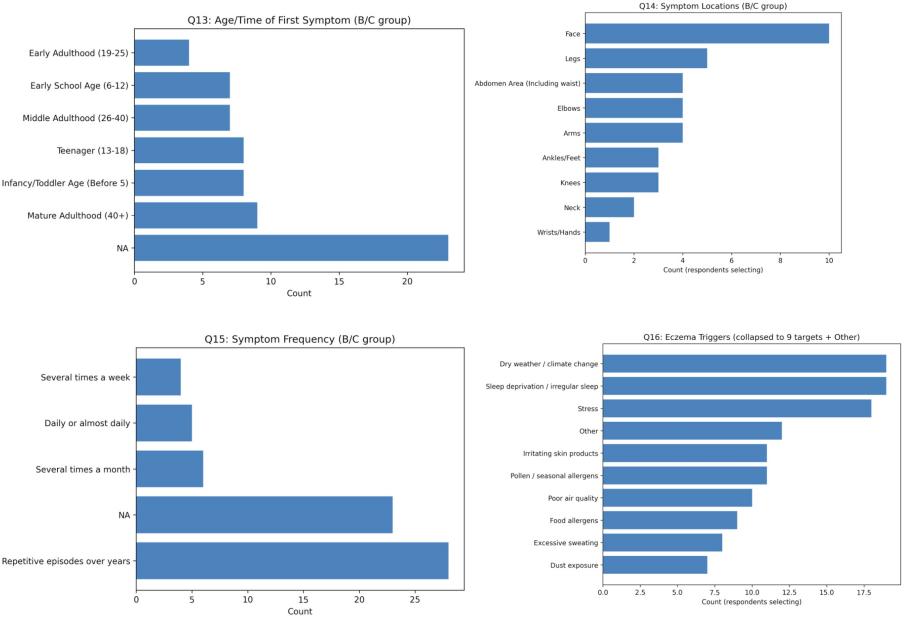
Eczema, or atopic dermatitis, affects nearly 10% of adults worldwide and imposes a heavy burden through chronic itch and impaired quality of life. While many genetic, immune, and lifestyle factors have been proposed, their relative contributions and interactions remain unclear, particularly across different age groups. To address this gap, we designed a survey-based study that systematically investigated demographic, behavioral, and environmental contributions to eczema among teenagers and adults. Survey items were developed based on an extensive literature review and targeted factors such as age, gender, stress, sleep, moisturization, and public awareness of skin conditions. Responses were analyzed using statistical method to identify significant associations and exclude spurious correlations, Among the numerous factors examined, age, gender, and moisturization habits consistently emerged as significant predictors of eczema. These findings refine our understanding of the condition by emphasizing significant correlates and clarifying misconceptions surrounding eczema. By distinguishing between meaningful associations and less relevant factors, this research contributes both to the scientific knowledge of eczema and to public health practice in managing one of the world’s most common skin conditions.
Show more
Read Article PDF
Cite
Research Article Open Access
Case Analysis of Rehabilitation Treatment for Postpartum Sacroiliac Joint Dysfunction
Low back pain is a common symptom in women during pregnancy and the postpartum period, which can be caused by various factors. Among them, sacroiliac joint dysfunction is one of the core inducing factors that are easily overlooked. This case report describes the evaluation and treatment process of a 30-year-old postpartum nurse with low back pain, and explores the efficacy of occupational therapy (OT) centered on posture management, three-dimensional breathing training, and neuromuscular activation in the treatment of postpartum sacroiliac joint dysfunction (SIJD). Through short-term OT intervention focusing on posture management and sequential activation of breathing - core - pelvis, within 2 months of treatment, the patient's postpartum SIJD pain was rapidly relieved, her activities of daily living were restored, and her daily functions related to the maternal role were improved.
Show more
Read Article PDF
Cite
Research Article Open Access
Recent Advances in the Biosynthesis of Representative Plant-Derived Natural Products in Pichia Pastoris
Pichia pastoris, isolated from California oak trees, is a methylotrophic yeast that utilizes methanol, glucose, etc. It has fast growth, suits high-density fermentation, low cost, and high biosafety, acting as an ideal chassis strain for high-value natural products in biosynthesis for decades. Widely used in microbial synthesis of plant-derived compounds (terpenoids, flavonoids, etc.), it provides green routes for pharmaceuticals, food, chemicals. Researchers have optimized gene expression elements (promoters, terminators) and developed genetic modification technologies like CRISPR/Cas9. This paper focuses on elaborating the key progress of Pichia pastoris in the synthesis of plant-derived natural products in recent years, including the optimization strategies of gene expression elements, breakthroughs in strain modification technologies, and the synthetic pathways and yield improvement achievements of representative products, and prospects the challenges faced in the construction of its cell factory (e.g., modification relying on the trial-and-error method, insufficient gene editing tools and genetic elements) and possible countermeasures (e.g., using multi-omics and computational biology to locate metabolic bottlenecks, and strengthening tool development and element exploration). This paper finds that Pichia pastoris still has broad room for improvement in the synthesis of natural products.
Show more
Read Article PDF
Cite
Research Article Open Access
Multi-specific T Cell Engager And Multi-specific Natural Killer Engager, the Novel Immunotherapy Approaches for Cancer Treatment
Article thumbnail
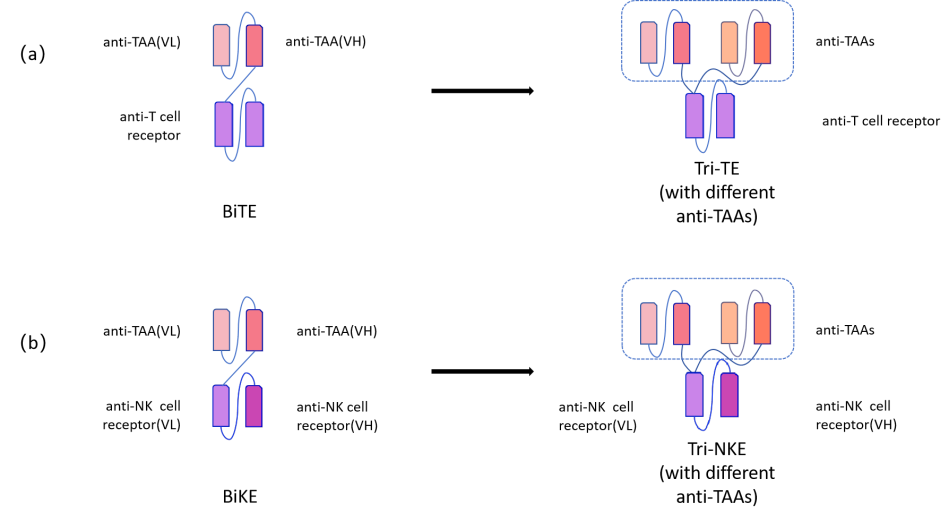
T cell engagers and NK cell engagers are the specialized multi-specific antibodies for cancer treatment. They recruit the immune cells to attack cancer issues, simultaneously induce tumor cell lyse activity by targeting their surface antigens. This article discussed the mechanism and development of multi-specific T cell engager and multi-specific NK engagers, as well as their current applications in tumor treatment and outlook on the future development. It might serve as a useful review for understanding the immune therapeutic approaches and shedding light on the development of more promising approaches for cancer therapy.
Show more
Read Article PDF
Cite