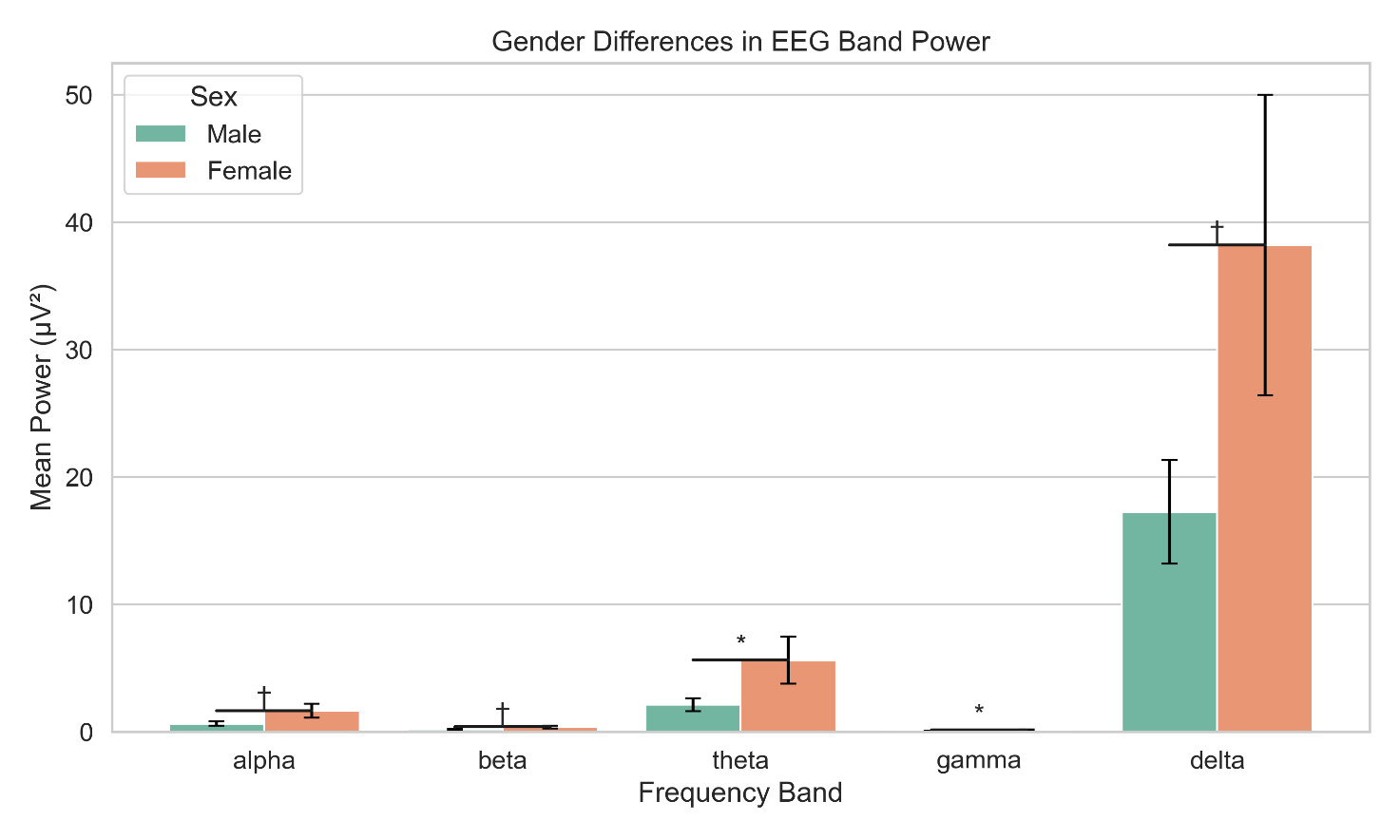
Meditative states provide a unique window into intrinsic neural activity, yet the spectral and spatial dynamics of resting-state EEG during meditation remain incompletely understood. This study examined how gender, age, and meditation experience influence EEG band power and spatial coherence during eyes-closed meditation. Twenty-four participants (12 experienced meditators, 12 novices) completed a resting meditation task while 64-channel EEG data were recorded. Epochs preceding self-report prompts were extracted, and power spectral density (PSD) was computed for five canonical frequency bands (delta, theta, alpha, beta, gamma). Analyses revealed that gender consistently predicted band power—males showed elevated beta, whereas females exhibited higher gamma and delta—while age and meditation experience had minimal effects. Inter-channel correlation matrices indicated strong inter-hemispheric synchrony and local coherence. Segment-wise one-sample t-tests across five temporal blocks demonstrated robust and temporally stable gamma-band enhancement, particularly in frontal and parietal regions; beta activity was selectively enhanced in males, and delta increases appeared in females and older adults. Meditation experience influenced only minor topographic patterns without significantly altering power. These results suggest that high-frequency gamma activity is a stable marker of resting-state cortical dynamics during meditation, modulated by gender and age but not substantially by prior training. The consistent spatial and temporal patterns highlight the stability and individuality of intrinsic brain states, contributing to mapping resting-state neural signatures and informing future research on attention, self-referential processing, and mindfulness-based interventions.