Articles in this Volume

Research Article Open Access
A Dual-Attention Meta-Learning Approach for Fine-Grained Classification of Gastric Cancer Histopathological Images with Limited Samples
Article thumbnail
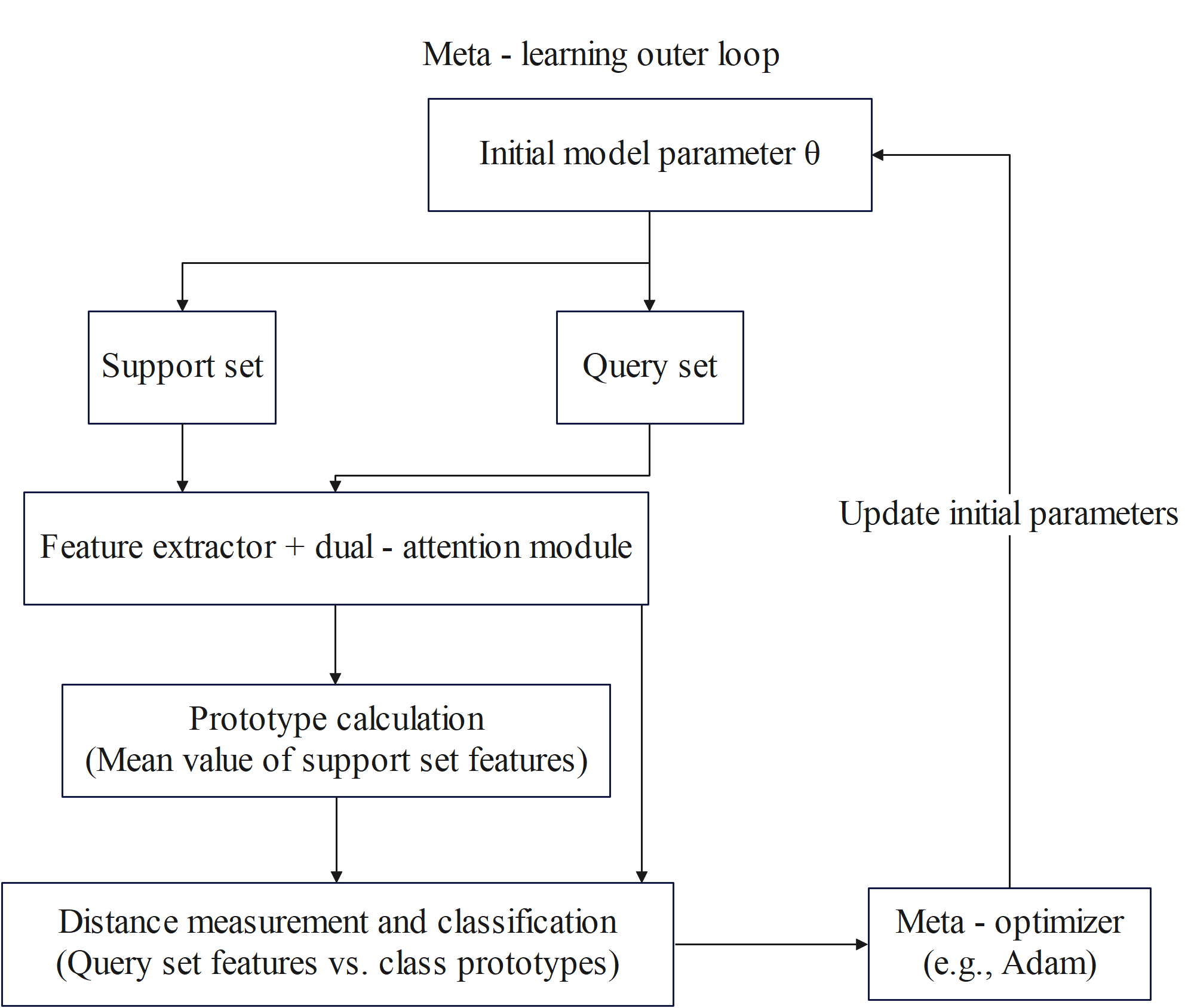
The pathological diagnosis of gastric cancer relies on the precise differentiation of its fine-grained subtypes, a process often challenged by the lack of annotated data. This study proposes a novel dual-attention meta-learning framework, aiming to address the problem of fine-grained image classification under fee-shot conditions in the medical field, and is particularly suitable for histopathological images of gastric cancer. This study proposes a meta-learning method combined with a dual-attention mechanism to enhance the recognition of imperceptible inter-class differences in pathological images. The channel attention module automatically selects key features by analyzing the information density of the feature map, while the spatial attention module precisely locates the morphological structure in the image. Supported by the meta-learning framework, this model can quickly adapt to new disease classification tasks with a limited number of samples. Experimental results on a self-constructed pathological dataset containing multiple fine-grained subtypes of gastric cancer show that the proposed mean is significantly superior to several benchmark models, demonstrating obvious performance advantages. This work provides a new technical approach for developing computer-aided diagnostic systems in the absence of annotated data.
Show more
Read Article PDF
Cite
Research Article Open Access
A Proactive Maintenance Framework for Road and Bridge Infrastructure Based on Digital Twin, BIM, GIS, and IoT Integration
Transportation organizations face pressing issues due to the aging of road and bridge infrastructure, rising traffic demand, and tight resources. Manual inspection and reactive repair, which are frequently ineffective, expensive, and unreliable, are significant components of traditional maintenance. Therefore, a change to proactive, data-driven management is crucial. The Digital Twin, Building Information Modeling (BIM), Geographic Information System (GIS), and Internet of Things (IoT) are all integrated in this paper's proposed unified maintenance architecture. Data collection, semantic integration, analytical modules, and decision optimization make up the architecture's four tiers. Three functional modules in this system, automated defect detection, time-series performance prediction, and network-level risk assessment, cooperate to convert unprocessed data into insights that can be used. After that, a portfolio of potential treatments is assembled and assessed using economic and optimization analysis. The system is flexible and scalable, making it appropriate for both regional networks and single bridges. It gives agencies a workable option to transition from reactive repairs to preventive stewardship by integrating transparency and traceability. Throughout the whole life cycle of infrastructure assets, this proactive strategy lowers emergency interventions, improves safety, and increases cost-effectiveness.
Show more
Read Article PDF
Cite