


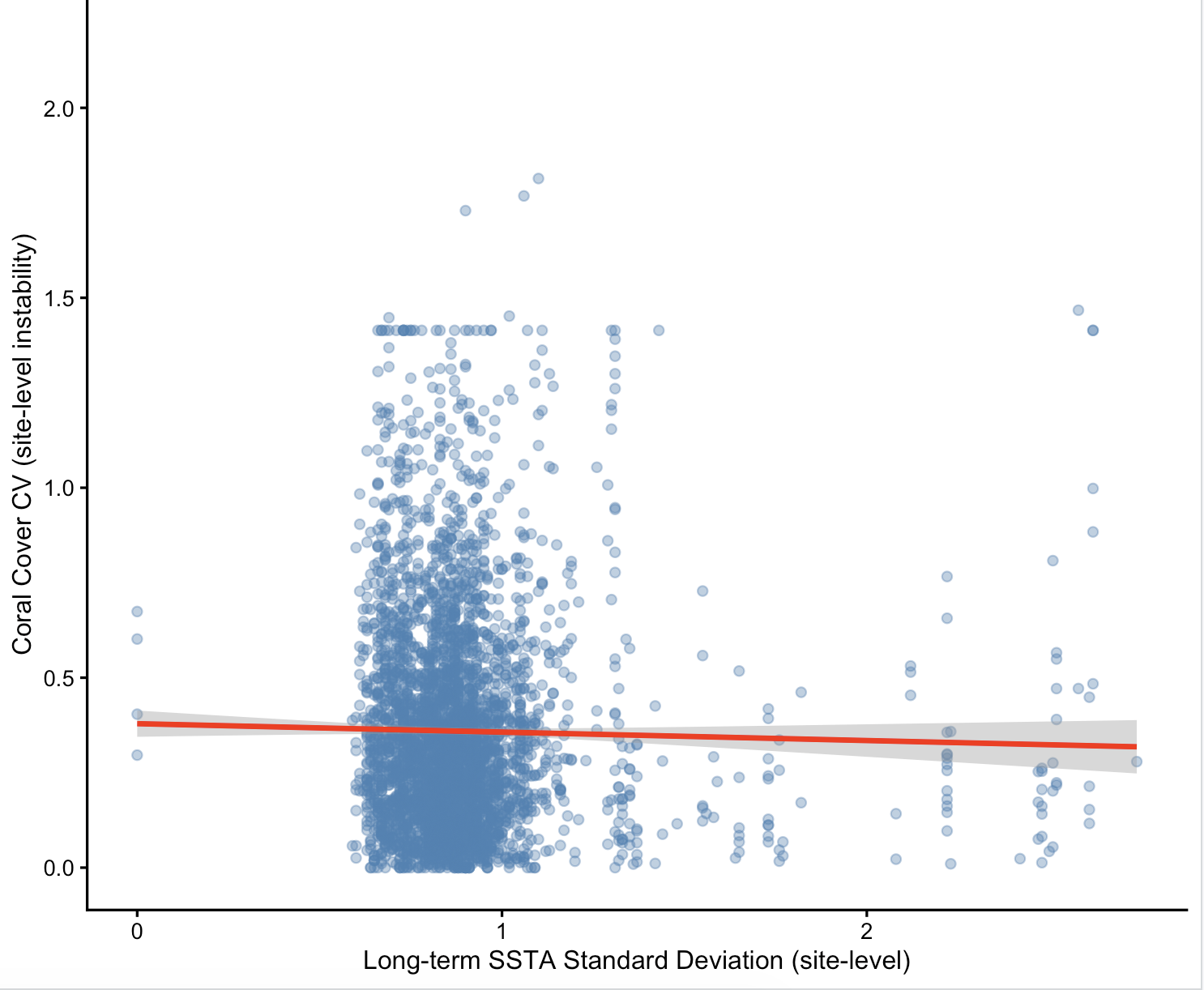
Coral reefs are one of the most biologically diverse ecosystems in the ocean, but are now under increasing threat from climate related ocean warming. While numerous studies have focused on the impact of sea surface temperature (SST) on coral reef condition, those that specifically looked into whether long-term background SST variability had an impact on reef stability have had conflicting results, with some analyses showing negligible association and others showing significant associations. This paper explores the reasons behind this contradiction, using the findings of new research and reanalysis of the Heatwaves and Coral-Recovery Database, a 44-year global monitoring dataset of over 12,000 reef sites. The standard linear correlation methods used to reanalyze SST variability over the long term revealed only a weak relationship between the SST variability and the two independently derived stability indices. For the coral cover data, however, acute peak thermal stress was a stronger predictor than background variability, site identity explained ~2/3 of the variance and nonlinear modelling revealed a strong U-shaped relationship, undetectable under the linear stress assumption; the same pattern was found for both measures of stability. A weak global effect also masked some strong ocean basin variation in the regional analysis, with even point estimates of opposite sign in certain regions. When combined with other parallel results reported elsewhere, these data suggest that the linkage between long-term SST variability and coral reef stability exists, but it is nonlinear, site-specific and regionally variable – not captured by a simple linear global analysis.