Articles in this Volume

Research Article Open Access
Erythrocytosis Driving the Breakdown of the White Matter–Cognition Cascade: Imaging Evidence for Precision Intervention
Article thumbnail
Chronic mountain sickness (CMS) is frequently accompanied by cognitive impairments, including memory loss and executive dysfunction, which seriously affect quality of life. Although extensive investigations have elucidated cardiopulmonary adaptations in CMS, the neuropathological substrates mediating cognitive impairment remain poorly characterized. This study investigated whether elevated hemoglobin/hematocrit (Hb/Hct) directly induces white matter (WM) injury and whether WM integrity mediates the Hb–cognition relationship. A case–control study was conducted with 20 CMS patients (Hb ≥ 20 g/dL, Hct ≥ 65%) and 20 matched healthy high-altitude residents, using multimodal assessments including diffusion tensor imaging (DTI), susceptibility-weighted imaging (SWI), cognitive testing, and hematological biomarkers. Results showed that Hb-related neurotoxicity, together with hemorheological disturbances, contributes to WM degeneration, which directly links erythrocytosis to cognitive decline in CMS. DTI-derived fractional anisotropy (FA) emerged as a potential early biomarker for CMS-related cognitive impairment and supports clinical interventions targeting Hct, such as considering phlebotomy when Hct reaches 58%.
Show more
Read Article PDF
Cite
Research Article Open Access
From Cells to Tissues: A Review of the Bioprinting Techniques for Organ Regeneration
Currently, the field of organ transplantation faces serious challenges such as organ supply shortages and immune rejection. As an emerging 3D printing technology, bioprinting holds promise as a potential solution to these issues. This paper aims to comprehensively analyze the core foundational elements, classification of key technologies, and application progress of bioprinting in organ regeneration. Through literature review and case studies, it explores the current status of bioprinting applications in constructing complex tissue and organ structures, identifying challenges such as bioink performance optimization, seed cell selection, and bioprinting precision. Empirical evidence demonstrates bioprinting's transformative potential for organ regeneration, but critical challenges persist—particularly in bioink biocompatibility, cell viability preservation, and structural durability of printed constructs—all requiring targeted research interventions. Future research should focus on developing novel bioinks, optimizing seed cell sources, and enhancing the precision and efficiency of bioprinting to advance organ regeneration technology.
Show more
Read Article PDF
Cite
Research Article Open Access
From Metronomes to Memories: Coordinated Slow Oscillations, Spindles, and Ripples in Sleep-Dependent Memory
Sleep plays a crucial role in consolidating memory, but recent research reveals that it is not the duration, but the timing and coordination of specific brain rhythms that matter most. Slow oscillations, sleep spindles, and hippocampal ripples interact during slow-wave sleep (SWS) to stabilize newly learned information and enhance recall. Evidence from human and animal studies—including closed-loop auditory stimulation (CLAS), transcranial slow-oscillation stimulation (tSOS), and ripple disruption—demonstrates that aligned rhythms strengthen memory, whereas disturbance weakens it. These findings highlight the practical importance of safeguarding early-night non-REM sleep and maintaining consistent sleep schedules. As wearable technology advances, personalized, phase-sensitive stimulation may offer new strategies to boost learning and cognitive resilience across the lifespan. Ultimately, sleeping smarter—by optimizing rhythm timing rather than simply increasing duration—may be the key to unlocking better memory, performance, and brain health.
Show more
Read Article PDF
Cite
Research Article Open Access
Functional Analysis of Associative Genes and Proteins Reveals Significant Biomarkers and Signaling Pathways in Dyslexia Patients
Article thumbnail
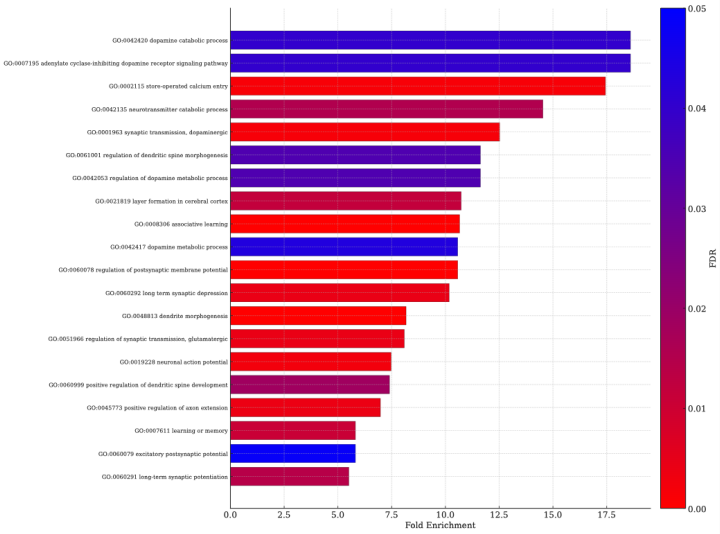
Dyslexia is a common neurodevelopmental disorder with a strong genetic component. Despite decades of research, its underlying molecular mechanisms remain poorly understood. In this study, we employed functional analysis of associative genes and proteins to compare the molecular differentiations of dyslexia patients and matched controls, aiming to identify differentially expressed genes (DEGs) and dysregulated biological pathways. We detected approximately 330 DEGs between dyslexia and control groups, with a subset of these genes mapping to well-known dyslexia candidates such as DYX1C1, DCDC2, KIAA0319, and ROBO1. Gene Ontology (GO) enrichment analysis highlighted significant dysregulation in pathways related to neuronal migration, axon guidance, synaptic transmission, and ciliogenesis. Notably, dyslexia brains showed enrichment of processes like chemical synaptic transmission and long-term synaptic potentiation, suggesting impairments in neuronal communication and plasticity. In parallel, genes involved in primary cilia structure and function were overrepresented, pointing to disrupted ciliogenesis and microtubule dynamics as a novel aspect of dyslexia’s etiology. These transcriptomic findings provide molecular evidence that dysregulated neurodevelopmental processes from cortical neuron migration to synaptic signaling and ciliary function, which underlie the structural and functional brain differences observed in dyslexia. This study enhances our understanding of dyslexia pathophysiology and opens new avenues for targeted research and therapeutic intervention.
Show more
Read Article PDF
Cite
Research Article Open Access
Effectiveness Evaluation of Tobacco Control Policies on Smoking Prevalence among Different Age Groups
Despite a slight global decline in tobacco use in 2022, tobacco consumption still poses severe health risks across all age groups, thus underscoring the necessity for targeted tobacco control policies. This study employs an age-stratified analytical framework, examining adolescents, adults and the elderly. For adolescents, smoke-free campus policies and the regulation of tobacco purchase channels have proven effective, albeit with existing rural-urban disparities; tobacco tax hikes exert minimal influence, and social media anti-smoking campaigns require optimization. In the case of adults, tobacco taxation (which has a more pronounced impact on low-income groups) and public place smoking bans yield positive results, while smoking cessation services call for enhanced accessibility and integration with medical insurance. For the elderly, community-based interventions and nicotine replacement therapy (NRT) hold promise, yet rural areas suffer from resource shortages and low NRT utilization. Additionally, tobacco control policies for adults also indirectly benefit adolescents. This paper provides empirical evidence to inform the formulation of age-adapted tobacco control strategies.
Show more
Read Article PDF
Cite
Research Article Open Access
Protein Secondary Structure Prediction Based on SSA-DNN Regression Algorithm
Article thumbnail
Protein secondary structure prediction is a fundamental task in bioinformatics, crucial for understanding protein function and guiding drug discovery. Traditional regression and ensemble models show limited performance due to their inability to capture nonlinear dependencies and sequential features of protein sequences. To address these challenges, this study proposes a hybrid model that integrates the Sparrow Search Algorithm (SSA) with Deep Neural Networks (DNN). SSA optimizes the initialization and hyperparameters of DNN, improving convergence and generalization. Furthermore, Online Low-rank Subspace Tracking by Tensor Decomposition (OLSTEC) is incorporated to exploit multi-dimensional correlations among sequence, evolutionary, and physicochemical features. Experimental results demonstrate that the SSA-DNN framework achieves superior accuracy over regression baselines, and the addition of OLSTEC further improves test accuracy to 36.82% with a Macro-F1 score of 0.1555. These findings highlight the advantages of combining metaheuristic optimization with tensor decomposition for large-scale protein structure prediction.
Show more
Read Article PDF
Cite
Research Article Open Access
Epidemiological Evidence Public Health of Shift Work Circadian Disorders on Population Health
Shift work and night-shift schedules disrupt circadian rhythms, causing chronic misalignment between internal clocks and environmental cycles—an issue increasingly recognized as a key determinant of population health. This study synthesizes epidemiological studies and mechanistic evidence to explore circadian disruption’s impact on population health and corresponding public health responses. Epidemiological studies consistently correlate shift work with heightened cardiovascular disease, metabolic disorder, malignancy, and mental disorder risk; mechanistic evidence supports correlations as circadian disruption alters endocrine regulation, suppresses glucose metabolism and reduces neurophysiologic clearance with sleep. Risks are concentrated disproportionately, with women, older adults, health care providers, and poor individuals carrying greater burdens as a result of biological and structural determinations. Current responses at the population health level are sparse and require personal (e.g., light exposure), organizational (e.g., schedule planning) and policy (e.g., protective regulation) intervention. Recognition of circadian disruption as an occupational hazard is fundamental for reduction of its global burden of illness and highlights extreme population health significance.
Show more
Read Article PDF
Cite
Research Article Open Access
Identify Potential Anti-radiation Molecule in Macrostomum Lignano
Article thumbnail
Macrostomum Lignano (M. lignano) has a strong ability to resist radiation up to 210 Gy. Potential anti-radiation molecules in M. lignano can be identified by comparative transcriptomic and proteomic analyses of specimens before and after radiation exposure. The following methods will be employed: RNA sequencing, Gene Ontology (GO) analysis, tandem mass spectrometry (MS/MS)–based proteomic analysis, and fluorescence in situ hybridization (FISH) combined with immunofluorescence. The identified proteins will also be transferred to other cell lines including Hek 293 and SH-SY5Y, which will demonstrate the potential of the newly found protein to help different species, including humans, resist high levels of radiation. This property may be of considerable utility for future space travel as well as for protection during radiotherapy.
Show more
Read Article PDF
Cite
Research Article Open Access
Research Progress on Multi-Mechanism Synergistic Antibacterial Preservation of Intelligent Fresh-Keeping Films
Article thumbnail
The global issue of food waste is severe, with food spoilage being a primary contributor. Although traditional preservation technologies offer certain benefits, they face limitations such as finite effectiveness and environmental unfriendliness. Intelligent fresh-keeping films represent a significant innovation in the food packaging sector, transitioning from single-barrier functions towards multi-mechanism synergistic functionalities. This paper systematically reviews recent research progress on the antibacterial and preservation capabilities of intelligent fresh-keeping films, elucidating their mechanisms of environmental perception, dynamic antibacterial action, and preservation maintenance. The temporal, spatial, and targeted synergy of multiple mechanisms enhances the overall efficacy of these films. Despite ongoing challenges related to cost and stability, the integration of materials science, nanotechnology, and the Internet of Things (IoT) holds promise for transforming intelligent fresh-keeping films from passive packaging into active management systems, providing crucial technological support for adding value to the food supply chain and promoting sustainable development.
Show more
Read Article PDF
Cite
Research Article Open Access
Health Branding Strategies and Consumer Perception of Vaccines in the Global Market
Article thumbnail
Today, vaccines play a vital role in preventing and controlling global pandemics, and public understanding of vaccine branding has become a key factor influencing their acceptance in the health market. This paper investigates how vaccines are health-branded in the global market and analyzes the impact of branding strategies on consumer trust, perceived efficacy, and behavioral response. By integrating public health frameworks with marketing theories, this study explores the branding trajectories of several COVID-19 vaccines, including Pfizer-BioNTech, Sinovac, and AstraZeneca, within different cultural and national contexts. Through detailed case study analysis, the paper reveals how vaccine branding extends beyond traditional marketing, becoming a critical tool in public health governance. Effective branding shapes health communication, reduces vaccine hesitancy, and directly influences immunization rates. This paper found that key factors, such as governmental endorsement, expert-supported messaging, platform-specific promotional campaigns, and public discourse, significantly affect individuals’ risk perception and trust in health authorities, leading to varied levels of vaccine acceptance even for the same product. The study concludes that vaccine branding must align with public health goals rather than be driven by commercial profit. It calls for the integration of behaviorally informed strategies and culturally adaptive communication in future global immunization campaigns. By leveraging social media for proactive public education and narrative shaping, vaccine producers and health authorities can more effectively guide public opinion. This paper contributes to interdisciplinary dialogue across global health governance, risk communication, and strategic brand management, particularly during times of health crisis.
Show more
Read Article PDF
Cite